The Hawking–Page Transition
A spherical AdS black hole can have positive heat capacity and still lose the canonical free-energy comparison to thermal AdS. The two statements become distinct at finite boundary radius. We compute both the local branches and the Hawking–Page crossing in four bulk dimensions, including the finite-cutoff matching that makes the comparison meaningful.
Preparation: Euclidean ensembles. Hold fixed the boundary geometry , with thermal rather than supersymmetric fermion boundary conditions.
Two smooth fillings of one thermal boundary
The Lorentzian spherical solution is
The boundary representative obtained with conformal factor is . The horizon condition gives
Thermal AdS has and any Euclidean time period. Its spatial sphere shrinks at , while its thermal circle remains noncontractible. For the black hole, the thermal circle shrinks at ; regularity fixes
In a theory with fermions, the smooth contractible circle supports the thermal spin structure. A periodic-fermion trace is a different problem and need not admit this filling.
Local branches and their heat capacities
Differentiating the temperature gives
There is a minimum at
Above this temperature, two radii have the same :
The entropy is . Together with , it gives
Thus the small branch has and is not a locally stable canonical equilibrium with a heat bath. The large branch has . Its lower-temperature segment will nevertheless remain subdominant to thermal AdS.
The finite action with matched periods
Let be a common large radial cutoff, , and the black-hole period. Identical induced geometries require
The two sphere metrics already match. The factor differs from one only by order , but multiplies a divergent volume. It cannot be discarded before subtraction.
For , the positive Euclidean metric has scalar curvature . Direct radial integration and the outward normal give
Thermal AdS has the same expressions with , and . Intrinsic counterterms cancel in this difference because the induced boundary metrics match. Expanding the complete difference gives
This equals , with thermal-AdS vacuum free energy chosen as zero in the AdS scheme. The calculation implements the matched-volume comparison in Witten, “Entropy Of Schwarzschild Black Holes”, with the boundary term explicitly retained. The companion separately checks the finite-cutoff radial integrals against this limit.
For a comparison with zero cosmological constant, the finite Schwarzschild cavity fixes the proper time period at a physical wall. It too distinguishes local heat capacity from dominance over a second filling.
Crossing and latent heat
The zero of is
For the large black hole is locally stable but has . Thermal AdS wins the comparison between these saddles. Above the large black hole wins. The small branch has positive throughout.
At the crossing, thermal AdS has no classical horizon entropy. Its thermal gas contributes at a lower order than . The leading jumps are
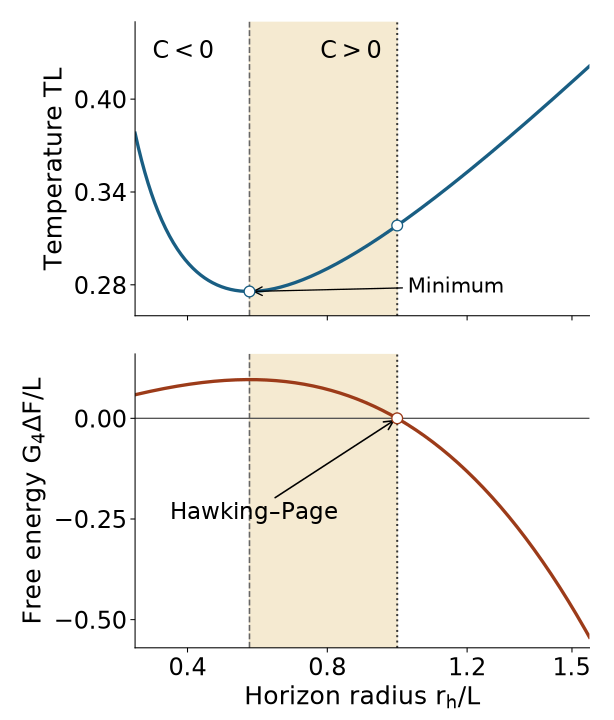
The dashed line marks , where the heat capacity changes sign. The dotted line marks , where the black-hole free energy crosses thermal AdS. The shaded interval has positive heat capacity but higher free energy. Both curves are the analytic AdS formulas derived above.
For reference, the dimensionless quantities and are:
| Canonical branch | |||
|---|---|---|---|
| Negative heat capacity | |||
| Turning point | |||
| Locally stable, subdominant | |||
| Crossing | |||
| Dominant over thermal AdS |
The saddle actions scale as . In a specified large-rank dual this can produce a sharp limiting transition even on a compact sphere. At finite rank and finite volume, a regular finite-temperature partition function sums the states rather than taking a strict minimum of two classical actions; the saddle crossing is rounded. A confinement interpretation additionally uses the gauge theory's representations, center symmetry and line operators. It does not follow for every CFT merely from this geometric crossing.
Summary
The canonical branch first becomes locally stable at , but overtakes thermal AdS only at . Matching cutoff periods recovers the finite potential, first law and latent heat. The result compares these semiclassical fillings at fixed thermal boundary data.
Exercises
- At , find both black-hole radii and their free energies. Which saddle has negative heat capacity?
Solution
The equation , with , has roots and . The larger has . The smaller has
Since , the small solution has negative heat capacity. The crossing therefore does not merge the small and large black holes; it exchanges dominance between the large hole and thermal AdS.
- In the explicit bulk-plus-boundary subtraction above, set prematurely. What wrong finite answer results, and what term corrects it?
Solution
At equal periods, the bulk difference per is . The Gibbons–Hawking difference is . Their sum is
The thermal-AdS bulk-plus-boundary expression grows as . Meanwhile . Restoring this factor changes the subtraction by , producing . The apparently vanishing lapse difference therefore contains the entire correction needed to recover the crossing.
References
- Witten, E. Anti-de Sitter Space, Thermal Phase Transition, And Confinement In Gauge Theories, hep-th/9803131, sections “The AdS Schwarzschild Solution” and “Entropy Of Schwarzschild Black Holes”. Smooth periods, matched boundaries and action comparison, followed by the gauge-theory interpretation. The HTML rendering has corrupted equation labels; the section titles identify the passages used.
Scrollable formula. Use Left and Right arrow keys to reveal hidden content.
Scrollable table. Use Left and Right arrow keys to reveal hidden columns.
Scrollable figure. Use Left and Right arrow keys to reveal hidden content.