Causal and Entanglement Wedges
A boundary region can encode bulk information outside the region that it can probe by sending and receiving light signals. Two separated intervals in the AdS vacuum make the distinction explicit: the causal wedge remains disconnected while the entanglement wedge can join across the gap.
Preparation: AdS causal structure and the two-interval entropy transition. We use classical Einstein gravity, the vacuum on the boundary line and the leading RT prescription. Quantum corrections can move the transition.
Define the two regions before comparing them
Let be the boundary domain of dependence of a spatial region . Its causal wedge is
It consists of bulk events that can both receive a signal from and send one to the boundary diamond. The entanglement wedge is the bulk domain of dependence of a homology region bounded by and its selected extremal surface :
These are spacetime regions. Drawings on a time-symmetric slice show their spatial sections, not their entire causal development. Under the usual semiclassical conditions one has causal-wedge inclusion; the reconstruction distinction and its assumptions are reviewed in Harlow, §5.1.
First solve one interval
In Poincaré AdS,
null paths are unchanged by the conformal factor. For an interval centered at with radius , the past and future boundary tips are . The causal wedge is
At this is the half-disk bounded by the RT semicircle. In this special vacuum single-interval case the causal and entanglement wedges coincide. That agreement should not be promoted to a general definition.
Two intervals give an exact transition
Take
Each diamond has radius and center . The causal wedge is the union of the corresponding two wedges. A curve entering from one diamond and exiting through the other cannot provide an extra bridge: their center separation exceeds the maximum tip-to-tip time . Causality therefore keeps the two components separate for every positive gap.
The RT candidates, by contrast, have regulated total lengths
The connected homology region wins when
Equivalently the cross ratio
exceeds . This is the same comparison of admissible endpoint pairings as in Headrick, §4.2, Eqs. (38)–(40), specialized to symmetric intervals.
On the slice the two phases are particularly simple:
- Below the transition, is the two causal half-disks.
- Above the transition, is the upper half-annulus .
The connected phase has two geodesic components, of radii and . “Connected” describes the homology region, not a single curve joining all four endpoints.
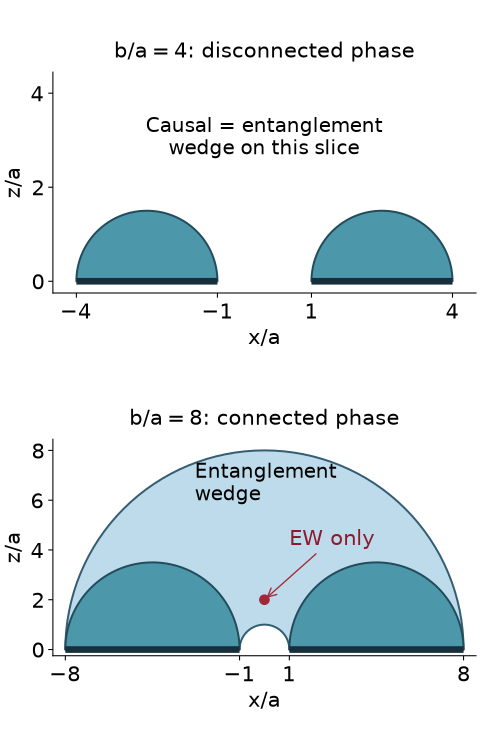
The causal region is the darker pair of disks. In the connected phase the lighter region contains additional bulk points, including the marked point . Boundaries are classical RT curves; the figure does not depict a quantum-corrected transition.
A point reconstructed beyond causal access
Set . For , and the wedge is disconnected. For , and the wedge is connected. In the latter phase the point lies between the two semicircles and hence in .
It is outside both causal disks. Indeed, each center is at and each radius is , whereas the squared distance from to either center is , larger than .
An entanglement-wedge reconstruction of an observable near is a statement about representation in the algebra of the union of the intervals, within a specified code subspace. It does not supply a causal communication channel to , or imply that either interval separately contains the observable. The finite code example will make this distinction algebraic.
The leading mutual information provides a boundary diagnostic of the same saddle choice:
A vanishing order- result leaves room for order-one bulk correlations. At the classical crossing, neither one fixed wedge nor the sharp minimum is a complete description of finite- physics.
Exercises
- Show directly that the causal disks lie inside the connected half-annulus when that phase is selected.
Solution
For the right disk, its center has distance from the origin and radius . The triangle inequality gives
so . The left disk obeys the same bounds. Their interiors therefore lie in the half-annulus, establishing the inclusion on this slice without relying on the figure.
- Compute the leading mutual information divided by for , .
Solution
The ratio entering the logarithm is . Thus
at leading order. The same logarithm is the disconnected-minus-connected entropy difference divided by .
- Does the exact equality define a unique entanglement wedge in the classical minimization problem?
Solution
No. The two admissible configurations have equal regulated area there. Classical minimization is degenerate. Selecting a unique semiclassical wedge requires additional information, such as quantum corrections or a controlled choice of nearby state and region. One cannot assume that a reconstruction formula valid well inside one phase remains uniformly valid through this degeneracy.
The distinction to retain
The causal wedge is determined by signaling; the entanglement wedge also depends on the state and the entropy saddle. Their difference is concrete even in vacuum AdS. Turning that geometric region into a reconstruction theorem requires an algebra, a code subspace and a controlled approximation, which we discuss next.
Scrollable formula. Use Left and Right arrow keys to reveal hidden content.
Scrollable table. Use Left and Right arrow keys to reveal hidden columns.
Scrollable figure. Use Left and Right arrow keys to reveal hidden content.