Complexity of Formation and Time Dependence
Does preparing a hotter thermal double require a larger geometric formation difference? In BTZ the answer is unexpectedly simple: with two global-AdS vacua as reference, both volume and action formation differences are independent of temperature. Their signs, normalizations and time dependence nevertheless differ. Computing them together separates preparation subtraction from subsequent growth.
Preparation: The volume and action prescriptions. Throughout, the boundary circle has radius , , and . The action includes its null expansion counterterm with fixed length .
Define a difference between preparations
At zero time the thermal double is
For either bulk prescription define
The two reference saddles are global AdS, with the same boundary metric and Fefferman–Graham cutoff as BTZ. For action, anchoring of the WDW sheets, null normalization and counterterm length also match. This is the formation subtraction of Chapman, Marrochio and Myers, §§4–5.
A subtraction of costs from a common reference is not the cost of a direct optimal circuit from the product vacuum to the thermal double. In a metric space, and are different functions. They need not have the same sign or obey the same composition rule. The field-theory comparison makes this distinction explicit for Gaussian states.
Calculate the temperature dependence rather than assume it
The zero-time volume integrals give
Using the matched radii
the difference tends to . The assembled WDW action instead has difference at zero time. Hence
Neither contains . In contrast, the one-sided thermal entropy and energy are
Thus at both formation differences divided by tend to zero. They scale as , not as . This special two-dimensional result is not an argument that every holographic formation difference is temperature independent. It follows from these particular radial integrals and the global reference.
Replacing the global vacua by two massless-BTZ reference patches changes the finite constants. Those geometries are not the same vacuum on the circle: the conventional BTZ massless state has , whereas global AdS has energy . Reference selection cannot be suppressed as an unimportant notation choice.
Compare the full time-dependent proposals
Keep the reference fixed while evolving the thermal double. The volume result is the finite integral from the preceding page,
The action gives
The positive-time normalized rates are
Both approach one, but from different sides. At zero time vanishes smoothly. The action rate diverges negatively as , even though its integrated value is finite. For , the volume data are obtained by solving the endpoint-time integral; the action rate is evaluated from the independently checked WDW result.
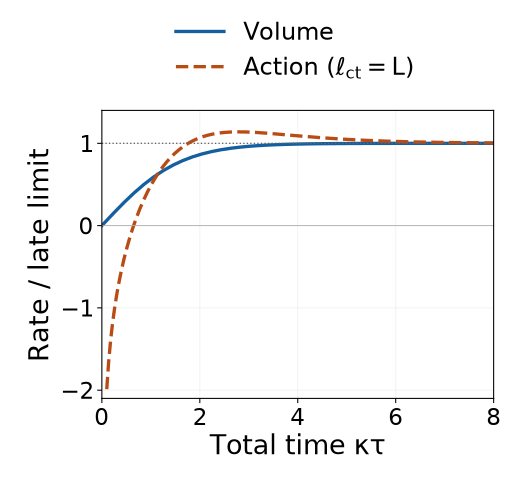
BTZ growth rates divided by their own late limits, with . The volume curve uses retained maximal-slice quadratures; the action curve uses the assembled WDW result. The action curve is shown only for ; its rate diverges to negative infinity as the origin is approached. Normalizing the late slopes does not align the finite-time curves.
The volume calculation retains 45- and 65-digit comparisons, a complete-elliptic-integral check and the endpoint derivative identity. The action calculation separately retains all boundaries and corners before its UV and singular limits. The comparison therefore does not determine one curve by fitting it to the other.
What matching a late slope does and does not achieve
The two late slopes are
Their ratio is . One could rescale the volume proposal by to match the late slope. That would change its formation difference to , still different from . An additional constant could align formation, but could not turn a smooth quadratic onset into a onset. The mismatch is functional, not only numerical.
Similarly, changing shifts action values at finite time by
It leaves formation and the late slope unchanged. Those two endpoint tests therefore cannot fix the entire prescription.
The late geometric growth is proportional to , consistent with an entropy times a thermal frequency. The same dimensional scaling can arise from many costs. It is useful evidence for a proposed correspondence only when the independently fixed boundary definition predicts more than the dimensions and an adjustable coefficient. Classical indefinite growth also omits the discrete spectrum and recurrence structure of a finite system.
Summary
For a BTZ thermal double relative to two global vacua, volume and action formation are temperature-independent constants proportional to . Their late rates both scale as , yet their onset and finite-time dependence disagree. A meaningful comparison must retain the state, reference, clock, cost normalization and action prescription.
Exercises
- Compute the high-temperature ratios of each formation difference to the thermal entropy.
Solution
Dividing by gives
Both vanish as grows at fixed . The action ratio is negative because a reference subtraction was made, not because the thermal entropy or an absolute circuit distance is negative.
- Rescale CV to match the late CA slope and then add a constant to match formation. Does this make the functions equal near zero time?
Solution
The required multiplicative factor is . The required additive constant is . The adjusted volume still has a finite zero derivative at the origin and a quadratic leading change. The action has a leading change. No constant multiplicative and additive transformation can remove this difference.
- In the action prescription, determine the positive time when the rate equals its late limiting value. How does this time depend on the counterterm length?
Solution
The rate equals when the logarithm vanishes:
Before this crossing the logarithmic correction is negative; afterwards it is positive and eventually decays. Thus a finite-time comparison remains sensitive to even though the asymptotic slope does not.
References
- Chapman, Marrochio and Myers, Complexity of Formation in Holography, §§4–5 and Appendix A: references and matched cutoffs.
- Carmi et al., On the Time Dependence of Holographic Complexity, §3 and Appendix A.2: the distinct volume and action time dependence.
Scrollable formula. Use Left and Right arrow keys to reveal hidden content.
Scrollable table. Use Left and Right arrow keys to reveal hidden columns.
Scrollable figure. Use Left and Right arrow keys to reveal hidden content.