Multiloop Integrands from Cuts
At two loops, different cuts see overlapping pieces of the same integrand. Adding every successful cut expression would count those pieces more than once. We will instead fit one numerator ansatz for the planar four-gluon amplitude of Yang–Mills, then test it with a three-particle cut that was not used in the fit.
Preparation: The complete one-loop box and five-point superamplitudes. We keep the same all-incoming spinor phases, color normalization and supersymmetry-preserving dimensional prescription.
Specify a representation before solving for it
Let , and . Define a planar double box by
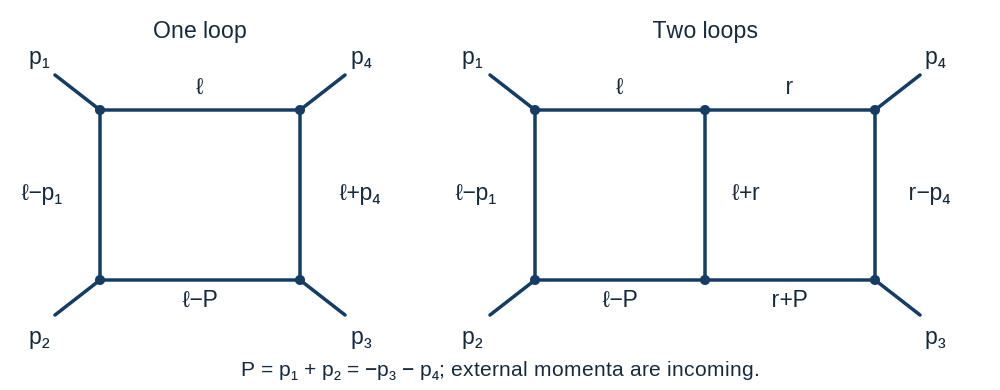
The box routing extends to two loops by adding a middle propagator with momentum . Each internal label is squared to obtain its propagator denominator; . The drawing is schematic and does not identify a loop momentum with a physical on-shell particle.
Its scalar integral is
The cyclically rotated topology gives . We seek the leading planar partial amplitude, whose full color coefficient is in the trace sum. Nonplanar double boxes are required for the complete finite-color amplitude; they are not silently included here.
For this four-point maximally supersymmetric example, supersymmetric power counting permits a representation with these double-box parents and no triangle subloops. Factor out the common , which already has four powers of external momentum. The remaining numerator has mass dimension two. A useful trial family is
The rotated parent uses the same four constants with cyclically relabeled momenta. Terms proportional to propagators can be distributed between a parent and its daughter contact graphs; we set that representational freedom aside here and discuss it below. The two loop–external scalar products test whether residual loop dependence is needed instead of assuming the familiar constant numerator at the start. The no-triangle topology restriction is a theory-specific input, supported by the supersymmetric power-counting argument in Bern–Rozowsky–Yan, §§5–6.
Use two different two-particle cuts
On the left cut , put and . The full sixteen-state tree sewing derived earlier is
Replace the right tree by its one-loop integrand. Its own adjacent invariants are , so its box numerator multiplies that tree by . The common-cut numerator is therefore
The factor restores the remaining left propagator; the four right-box propagators stay in the double-box denominator. No loop integration or final two-loop answer was inserted in this step.
The right cut instead replaces the left tree by its one-loop integrand. Reversing the cyclic external order gives the same numerator. On the first cut is constrained and remains free; on the second, is constrained and remains free. Thus the two cuts test the two loop-dependent terms separately. Varying the scattering angle separates the coefficients of and .
For a finite reconstruction, evaluate the four trial functions at several nondegenerate points on each cut. The right-hand side is computed from the tree supersum and the already determined one-loop insertion, not entered as the anticipated coefficient vector. The resulting linear system has rank four and gives
Using twelve samples across the two cuts gives singular values approximately , so no trial coefficient is unconstrained. The fitted coefficient error is below for these samples. This establishes the finite linear reconstruction within the declared ansatz.
Cyclic relabeling fixes . The common integrand is written once, yielding
The positive sign follows our two factors in the loop measure. The source's scalar double box uses two unnormalized measures and its amplitude includes an overall ; translating both converts its negative coefficient into the one above. A sign comparison that translates only the tree amplitude would fail.
Hold out a genuinely different cut
A three-particle cut splits the diagram into two five-point trees. Choose null with , and use cyclic orders
This cut was not used to determine the four constants. It includes both MHV times anti-MHV and anti-MHV times MHV sectors; keeping only one misses part of the supermultiplet sum.
For a five-leg ordered tree and one flavor, write
The arrow means increasing leg order. This second polynomial is the Grassmann Fourier transform of the conjugate MHV delta function; its overall sign per flavor is immaterial after multiplying four flavors. The complete five-point supertrees are
The anti-MHV gluon component has three negative helicities and numerator equal to the fourth power of the bracket between the two positive legs. Its positive sign is the parity translation of the site's negative five-point MHV phase, not an independent choice.
Multiply the left/right polynomials, with , and extract each of the three internal variables once for every flavor. For either adjacent or separated negative external gluons, Schouten identities and momentum conservation reduce the result to
where the six remaining tree channels are
This is also exactly the cut of the fitted integrand. The first two terms are the two distinct three-particle cuts of the double box; the last is the cut of the rotated double box. They are three embeddings of two graphs, not three independently integrated copies of the amplitude. The polynomial formula above supplies a direct way to reproduce the state sum without using the double-box answer. The retained calculation uses it on kinematics and helicity components excluded from the fit, and also checks a nondegenerate one-parameter complex family symbolically.
For twenty further three-particle kinematic points and both external helicity placements, the direct five-point state sum agrees with the fitted cut to a normalized residual below . Omitting the rotated box fails this comparison. A separate exact rational-function check on a one-parameter complex family gives zero difference away from its poles. These are checks of the stated identity, not a classification of every possible two-loop integrand.
What the reconstruction establishes
A full-rank finite fit determines the four coefficients of the declared ansatz. The unused cut tests a different factorization and its state sum. Neither statement alone proves that no other topology or extra-dimensional numerator exists. The additional theoretical input for this specific four-point result is that the two-particle sewing identity has a dimensionally valid completion and that supersymmetric power counting excludes extra-dimensional numerator terms in the remaining graphs without two-particle cuts. Bern–Rozowsky–Yan §6 gives that argument. Ordinary nonsupersymmetric QCD does not share it; the rational-term example explains why four-dimensional samples can then miss finite terms.
The displayed double boxes are unintegrated representatives until the Feynman integrals are evaluated. Generalized gauge changes can redistribute numerator terms while keeping the total integrand unchanged; an integration-by-parts identity can change the integrand pointwise while leaving its regulated integral unchanged. These are different equivalences.
Exercises
1. A parent–daughter redistribution
Let . Add to a double-box numerator. Find the daughter term that leaves the total rational integrand unchanged. Which cut fails to distinguish the two numerator assignments?
Solution
Add as a six-propagator daughter. Then
A maximal cut containing sees no change in the parent numerator. A cut that does not set to zero sees the redistribution but still finds the same sum. This is an exact rational identity, with no integration-by-parts assumption. Discarding the daughter after changing the parent would change the amplitude.
2. Detect an incomplete three-particle cut
Suppose the rotated double box is omitted after fitting the -channel two-particle cuts. Calculate the missing three-particle contribution. Why can its absence not be repaired by counting the two -box embeddings twice?
Solution
The missing contribution is . The two existing terms have denominators and . Their pole sets differ from that of : multiplying by the common denominator leaves instead of . Generic null cut momenta do not make vanish. Duplicating the two terms changes the first polynomial rather than supplying the missing one. The held-out five-point state sum therefore detects a topology that a restricted channel fit could miss.
References
- Z. Bern, J. S. Rozowsky and B. Yan, “Two-Loop Four-Gluon Amplitudes in Super-Yang–Mills,” hep-ph/9702424 (1997), §§4–6, Eqs. (8)–(17), and Figure 3. Primary paper.
- H. Elvang and Y.-t. Huang, Scattering Amplitudes, arXiv:1308.1697v2 (2014), §§4.3 and 6.2. Author manuscript.
Scrollable formula. Use Left and Right arrow keys to reveal hidden content.
Scrollable table. Use Left and Right arrow keys to reveal hidden columns.
Scrollable figure. Use Left and Right arrow keys to reveal hidden content.