Double Copy at Loop Level
A tree relation can be tested on a loop amplitude by cutting propagators and comparing products of trees. This is more informative than merely squaring a loop numerator: the cut exposes which states propagate and whether the proposed integrand has the correct normalization.
Our example is the supplied one-loop four-point representation of super-Yang–Mills theory and its double copy to supergravity. We will verify two independent two-particle channels, including a channel with a nontrivial intermediate supermultiplet sum.
Preparation. One-loop unitarity, superamplitudes, KLT relations and gravity state content. All momenta enter. Set , , ; gauge partial amplitudes and reduced gravity trees use the invariant-amplitude phases already fixed there.
Specify the integral and the proposed integrand
Define the scalar box, including its normalization, by
It contains no coupling, color factor or additional . In the normalized trace basis , the leading single-trace full gauge amplitude has factor multiplying the partial amplitude, whereas the tree has factor . The supplied partial result is
The box numerator is independent of loop momentum. Its permutations agree as a superamplitude by the four-point BCJ relations. A Jacobi difference between two adjacent box numerators is therefore zero, matching a vanishing triangle numerator; bubbles likewise have zero numerators in this representation.
Squaring these numerators with the loop vertex/integration phases gives the supplied gravity result
Equivalently the common coefficient is . The tree identity fixes this equality. The gravity loop expression has a plus sign with this integral measure; the Yang–Mills partial coefficient has a minus. In references where a tree includes an overall and the scalar integral is written without , both translations must be made together.
The cited dimensionally regulated result uses a supersymmetry-preserving prescription. The four-dimensional cut calculation below verifies its four-dimensional state and kinematic cuts. By itself it does not establish all terms sensitive to the extra loop-momentum dimensions.
Sew the gauge-theory states explicitly
Put , with . The ordered trees on the cut are
The diagram fixes the momentum flow used in the following state sum.
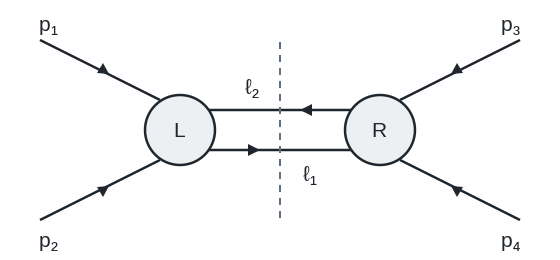
The -channel two-particle cut, drawn schematically. All four external momenta enter; . Each cut line carries a complete physical state sum. The two trees are not individual cubic vertices.
Keep the spinor reversal , . For one supersymmetry flavor, introduce internal Grassmann variables and set , , and similarly for . Then the supermomenta of the two trees add to the external supermomentum.
For any four legs the one-flavor polynomial is
Use external variables in leg order, followed by , and let extract the coefficient of . Multiplying the two quadratics gives
Four flavors produce a positive fourth power of this factor. If the two negative external gluons are , and , the resulting component sum is
Use the on-shell cut conditions and momentum conservation to reduce the angle ratios. With and , one obtains
This is precisely the proposed box coefficient divided by the two uncut propagators. In this invariant-amplitude convention no extra minus is to be attached to the naked tree product. Converting a formula written with two trees already contributes a minus; counting it again would reverse the answer.
See the non-singlet sum, not just its final power
For negative helicities on , only one internal state assignment survives in each flavor. For negative helicities on , the coefficient before taking the fourth power has two terms:
The last equality is Schouten's identity. The expansion has state-pair assignments. Keeping only retains the two gluon assignments and misses the fermions and scalars. The mixed terms are essential.
For there are eight flavors, so the analogous non-singlet sum has assignments. This is the tensor product of the two complete multiplets. It is not a pure-graviton sum.
Sew two gravity trees and recover the boxes
Apply the four-point KLT relation separately to the two gravity trees. Each has superamplitude prefactor
multiplying . The explicit eight-flavor state sum therefore gives
Define the other two uncut denominators and . On the cut,
The KLT expression reduces to
Thus the gravity cut has four partial-fraction terms. This does not imply four distinct scalar boxes in the channel. The two cut particles are unordered, so their complete phase-space sum has a factor . The interchange exchanges and . If
then the pointwise identity is . Consequently the symmetrized box cut equals , with the same measure and multiplicity. These are the two boxes and that have this cut. Relabeling gives the other channels and supplies the third box.
The retained calculation constructs the Grassmann polynomials and KLT tree prefactors independently of the proposed box coefficients. It checks eight generic complex cut configurations in the and channels, with both adjacent and separated negative-helicity choices: 16 component cases. Gauge cuts agree within ; gravity cuts and their identical-state symmetrization agree within . Deleting the non-graviton terms fails the separated-helicity test. These analytic cut configurations need not lie on a real physical phase-space contour; the identities are rational on-shell identities before integration.
What is established at loop level?
The tree double copy can be used on every generalized cut. A loop integrand is correct when a sufficient set of cuts reproduces the required tree products and state sums, with the regulator and possible cut-invisible contributions controlled. The present example has a particularly simple BCJ representation: equal box numerators and vanishing triangle numerators.
In a less simple representation, an arbitrary squaring can fail the cuts. Contact corrections may be required; a numerator containing an inverse propagator cancels that propagator and contributes to a lower-topology graph. Maximal cuts alone can miss these terms. Four-dimensional cuts can also miss rational or dimension-dependent contributions, as explained in rational terms.
Thus distinguish three statements: tree relations with established constructions; particular loop representations that have been checked; and the general conjecture that suitable dual representations exist in wider classes and at arbitrary loop order. This example demonstrates the second using the first. It does not establish the third.
Exercises
1. A term invisible on a maximal cut
A box numerator is changed by , with constant . Explain why a quadruple cut misses this change but a suitable two-particle cut detects it.
Solution
The changed integrand contains
On a quadruple cut the original numerator shift vanishes at . But a two-particle cut through, for example, leaves , which is generally nonzero. The shift is a triangle contact contribution. It cannot be discarded merely because the maximal box residue is unchanged.
2. Why a graviton-only test is insufficient
For a non-singlet cut with one-flavor contributions , compare with . What theory does the latter fail to test?
Solution
Their difference is
These mixed assignments contain the other states in the multiplet. Unless or vanishes or a special cancellation occurs, the difference is nonzero. The two extreme assignments alone therefore do not test the supplied integrand. They are part of a graviton-only cut, but constructing a pure-Einstein loop amplitude requires that restricted state sum consistently in all cuts, not simply deleting terms from the already integrated supergravity result.
References
- Z. Bern, J. S. Rozowsky and B. Yan, Two-Loop Four-Gluon Amplitudes in N=4 Super-Yang–Mills, §3, printed p. 3, Eqs. (2)–(5): the one-loop input, integral definition and supersymmetry-preserving prescription.
- Z. Bern et al., The Duality Between Color and Kinematics and its Applications, v1, §6.1, printed pp. 108–110, Eqs. (6.3)–(6.12), and Appendix C.1–C.2, printed pp. 177–180: the box double copy and explicit two-particle cuts. The phases and cut multiplicities are translated above.
Scrollable formula. Use Left and Right arrow keys to reveal hidden content.
Scrollable table. Use Left and Right arrow keys to reveal hidden columns.
Scrollable figure. Use Left and Right arrow keys to reveal hidden content.