Coupled-Channel Unitarity
Two reactions can share an angular momentum while having different thresholds. A matrix of amplitudes then conserves probability only after each channel is weighted by its available phase space. A real interaction matrix diagonalized before these weights are included need not reveal the physical scattering eigenchannels.
Preparation: Identical-scalar partial waves and elementary Hermitian matrices. We develop one wave for two channels, and , with masses . Each pair consists of identical scalars and uses the full labeled sphere with .
The threshold-weighted identity
Normalize each channel by in this wave. The column index labels the initial channel. The off-diagonal operator identity uses the Hermitian absorptive part , not entrywise imaginary parts in an arbitrary basis. Summing the open intermediate channels gives
Here collects omitted physical intermediate states in this angular-momentum sector. It is positive semidefinite because for every initial vector , is a sum of squared amplitudes into those states. For two complete elastic channels . Time-reversal invariance permits a suitable phase convention with symmetric , but is not needed for the Hermitian matrix identity.
On the open-channel subspace define
The factors of convert amplitude coefficients to states with equal incident flux normalization. At an exact threshold this map is singular; use its continuous limit from the open region, rather than treating a zero-flux channel as an additional normalized scattering state. These weights implement the phase-space relation discussed in PDG, §50.1.3.
A solvable two-channel model
Choose a common mass unit, , , and the constant real symmetric matrix
Take positive above threshold and positive imaginary below it. The model specifies an amplitude, not a derivation of from a microscopic Lagrangian. A constant omits left-hand singularities and is not automatically a crossing-symmetric or ultraviolet-complete field theory; these limitations matter when using the K-matrix parametrization, §50.3.2. In particular, the square-root continuation introduces a branch at ; this unitarization alone does not reproduce the massive bubble’s dispersive analyticity.
For real positive , the imaginary part of comes only from open channels. Thus . Multiplication on the left by and on the right by proves
This verifies the nonlinear relation exactly wherever the inverses exist. Below the second threshold, makes its contribution to the real inverse. It changes elastic scattering virtually, but creates no outgoing probability. Only the open block of has a physical state interpretation there.
At , both channels are open and . Direct inversion gives
For incident channel 1, the diagonal identity is
The channel-conversion probability in flux-normalized states is . The survival probability is correspondingly . These sum to one, even though the elastic channel alone has an inelasticity smaller than one.
Find the eigenchannels after the weights
Above both thresholds set . It is real symmetric and
An orthogonal matrix diagonalizing therefore diagonalizes . If its eigenvalues are , then
At , and radians. The different threshold weights make these eigenvectors energy dependent even for constant . Diagonalizing itself generally mixes states with unequal flux normalization and does not diagonalize the physical .
The figure follows the conversion probability and the two eigenphases. The second channel opens at energy 4; the probability vanishes continuously there even though its unweighted transition amplitude is finite.
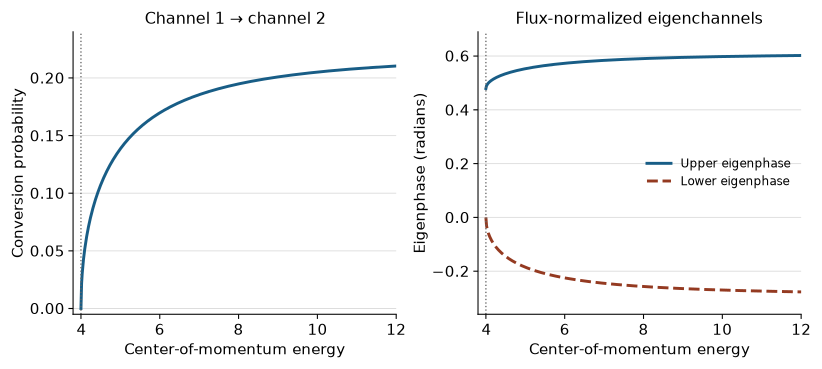
The specified constant- model with , . The left panel plots ; the right plots the two eigenphases of the flux-normalized matrix in radians. The horizontal coordinate is energy in the common mass unit. This is an exactly unitary two-channel model, not a fitted cross section. Original figure: QFT.org.
Summary
Coupled-channel unitarity uses a Hermitian absorptive matrix and one phase-space weight per open channel. Flux normalization exposes the unitary or contractive matrix. In the solvable model, virtual propagation in the closed channel affects scattering, and the eigenchannels vary with energy.
Exercises
- At an energy above both thresholds, suppose an analyst keeps only but claims exact one-channel elasticity. Find the missing positive term and express it through the measured conversion probability.
Solution
The missing term is . Multiplying the diagonal identity by yields
Thus . At the stated energy 5 this is approximately . Removing an open channel produces a contractive elastic block, not a failure of the full two-channel model's unitarity. Below its threshold the conversion term vanishes, although its real inverse contribution need not.
- Rephase the channel basis by . Show why entrywise imaginary parts cannot replace , and explain when diagonalizing does give the physical eigenchannels.
Solution
The transformed amplitude is , and the threshold matrix commutes with . Hence
For an initially real symmetric off-diagonal entry, multiplication by can create an entrywise imaginary part without adding any absorptive process; the Hermitian difference has the correct covariance. If is proportional to the identity, is a scalar multiple of , so their eigenvectors coincide. They also coincide in a basis where and commute, including a decoupled model. For the nonzero mixing and unequal thresholds used here neither condition holds generically.
References
- Particle Data Group, “Resonances” (2025), §50.1.3, Eqs.(50.9)–(50.15), and §50.3.2, Eqs.(50.39)–(50.41), for multichannel unitarity and K-matrix parametrization. Identical-pair and factors are fixed by the preceding article.
Scrollable formula. Use Left and Right arrow keys to reveal hidden content.
Scrollable table. Use Left and Right arrow keys to reveal hidden columns.
Scrollable figure. Use Left and Right arrow keys to reveal hidden content.