Glauber Exchange and Factorization Limits
An interaction between fast spectators can leave an inclusive hard rate unchanged while changing a measurement of the spectators themselves. This is the simplest way to see why factorization depends on what is measured. We will power-count the exchange, then calculate the real and absorptive cuts of a regulated spectator scattering model for two different measurements.
Preparation: The optical theorem, leading regions and soft Wilson lines. The explicit model is a commuting color channel with smooth transverse wave packets. Smooth packets let us isolate the cancellation in this channel.
The Glauber region can contribute at leading power
Let two spectators have opposite large light-cone momenta of order . A Glauber exchange has
A forward spectator loop has measure . Its exchanged propagator and two nearly on-shell spectator propagators each scale as ; the eikonal numerator supplies . The product scales as . Thus the region is not excluded by a power suppression.
A representative spectator denominator is . In a conjugate amplitude the pole is reflected. Products such as display a pinched contour. The transverse term is as important as ; deleting it by an ordinary-soft approximation changes the region. Whether a sum of graphs and cuts permits contour deformation or cancellation is a further question, not a consequence of the scaling alone.
Define a finite transverse scattering problem
Use the relative transverse separation of the spectators and its conjugate momentum . Normalize the incoming state by
The center-of-mass transverse coordinate factors out. At leading eikonal order a real transverse potential gives a unitary phase . In a fixed commuting color channel a screened, ultraviolet-smoothed exchange has the concrete form
Here includes the coupling and the chosen color eigenvalue. Screening and transverse smearing are explicit regulators of this model. The kernel retains the transverse Glauber propagator. Its phase is real, and its gradient is square integrable against the wave packet.
For an entirely analytic example below we also use . This is a smooth finite-range phase, not the unscreened propagator. It allows every cut integral to be evaluated and serves as a controlled diagnostic of the same unitarity/measurement algebra. The retained program separately checks the screened-propagator case.
Sum the cuts with the measurement in place
For a final-state measurement operator , the measured probability or weighted rate is . Through second order in the phase,
The middle real cut is . The two absorptive cuts are the terms with on either side. Their relative coefficients follow from , equivalently the forward optical theorem; they are not optional subtraction terms.
For the fully inclusive measurement , the linear term vanishes and the second-order sum is pointwise. In fact the cancellation is exact to all orders. A measurement depending only on the total pair momentum also commutes with this relative-coordinate interaction. This illustrates why a color-singlet recoil measurement can retain a cancellation that a spectator-sensitive measurement loses.
For the measured relative squared recoil, , one can calculate without expanding:
The cross term vanishes because and are real. Consequently
unless the phase is constant on the packet. The initial value is . This nonzero weighted sum is fully compatible with unitarity: is not the identity. For zero total transverse momentum, the sum of the two spectators' squared momenta is , so the result directly changes that measured quantity.
Evaluate the real and absorptive terms separately
For the Gaussian phase, define . Fourier transformation gives
The second-order change of the momentum density is therefore
The first term is the middle cut ; the second is the sum of the two absorptive interferences . Their inclusive integrals are equal and opposite:
Weighting by instead gives
The last result agrees with the direct gradient integral. Thus the same graphs cancel for one measurement and fail to cancel for the other. With , the increase is even though the total outgoing probability stays exactly one.
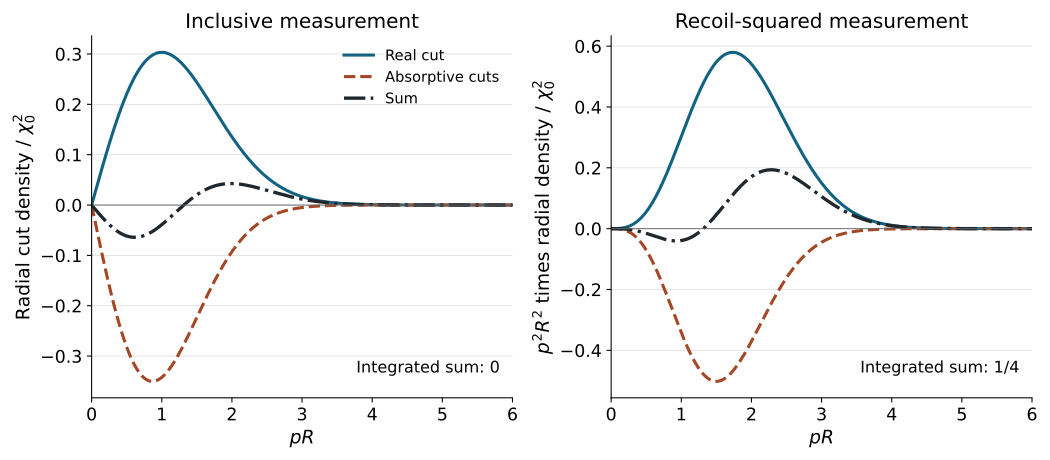
Left: the second-order radial density for , divided by ; its real and absorptive areas cancel. Right: multiplying the same curves by emphasizes the larger-recoil tail, giving . Curves are the analytic Gaussian cut functions, not simulated hadron data.
Retain the transverse propagator as a separate check
A Schwinger parameter evaluates the angular momentum integral of the screened phase:
Differentiate under the convergent integral and insert the Gaussian packet. Performing the integral exactly gives a positive two-parameter expression,
The retained calculation compares this with an independent radial gradient quadrature for finite positive . This verifies the model with its explicit transverse propagator; it does not remove its regulators or establish non-Abelian hadronic factorization by a numerical calculation.
What fails, and what remains justified
A factorization proof must establish cancellation with the actual measurement inserted in the cut sum. Replacing that measurement by the identity is legitimate only when the observable is insensitive to the spectator rearrangement at the claimed power. In Gaunt's two-Glauber analysis, inclusive sums and color-singlet transverse recoil permit a cancellation, while a spectator-sensitive transverse-energy measurement weights the real and absorptive cuts differently. His Eqs. (2.7)–(2.12) display this difference in a field-theoretic spectator model.
Our recoil-squared example proves the measurement dependence in a regulated transverse scattering model. It does not prove that every jet veto violates factorization, or that the inclusive DIS formula fails. Nor does it calculate a proton's spectator correlations. When leading Glauber contributions survive, one must retain the appropriate interaction operators and correlated matrix elements, or establish a more restricted factorization statement. A formula with only two universal single-hadron PDFs and an unchanged short-distance coefficient cannot simply discard a measured correlation that its cancellation argument has not removed.
Summary
Glauber exchange can be leading power and pinched. Inclusive unitarity cancels its real and absorptive contributions in the finite spectator model. The recoil-squared measurement changes their weights and leaves a positive, explicitly calculable correction. This demonstrates the role of measurement in a cancellation argument while keeping the model's regulators, color restriction and hadronic limitations explicit.
Exercises
- For the Gaussian phase, take and then . Explain both limits of the recoil correction, holding fixed.
Solution
For , : the phase is nearly constant over the packet. For , the correction approaches . Although the affected probability is only of order , its gradients are of order , leaving a finite weighted integral. The limit is nonuniform for the unbounded observable ; it does not imply a finite-probability broad change of the inclusive state.
- Let be any bounded measurement commuting with multiplication by . Prove exact cancellation and contrast this with a momentum projector.
Solution
Commutation implies by functional calculus, hence exactly. A projector onto a momentum bin is nonlocal in and generally fails to commute with a nonconstant phase. Its second-order change is the bin integral of for the real Gaussian input; opposite signs in different bins cancel only when the entire momentum plane is summed. Therefore exact total probability conservation does not imply bin-by-bin cancellation.
References
- J. R. Gaunt, “Glauber Gluons and Multiple Parton Interactions”, §2, Eqs. (2.7)–(2.12): real/absorptive cut cancellation and the changed transverse-energy weights.
- G. Sterman, “Comments on collinear factorization”, §§2–2.1: inclusivity, eikonal approximations and contour deformation.
Scrollable formula. Use Left and Right arrow keys to reveal hidden content.
Scrollable table. Use Left and Right arrow keys to reveal hidden columns.
Scrollable figure. Use Left and Right arrow keys to reveal hidden content.