Feynman Rules and Diagram Symmetry Factors
The quartic scalar interaction gives a tree vertex . Join two such vertices into a four-point bubble and its coefficient includes . Where did that half come from? Counting labeled Wick contractions gives the answer before choosing any loop momentum. The same drawing will then tell us which intermediate particles can appear on shell.
Preparation. Use Wick’s theorem to pair free fields, the normalized perturbative expansion to remove vacuum components, and scalar LSZ to interpret external poles.
Expand one specified theory
In four spacetime dimensions take a massive real scalar with
The interaction is not normal ordered. Use the same ultraviolet regulator and vacuum prescription in numerator and denominator. With the vacuum selected as in perturbative correlators, the formal expansion is
Every Wick contraction on the right is a free propagator. The resulting series describes an interacting correlator order by order; it does not assert Gaussian factorization of exact Heisenberg fields. A switching function can be retained at intermediate stages. Below, translation-invariant momentum formulas describe the constant-coupling perturbative coefficients in infinite spatial volume, with divergent integrals still regulated.
At first order in the two-point numerator there are fifteen pairings. Twelve attach the two external fields to the interaction point: there are four slots for , three for , and one way to pair the two unused slots. The other three pair with and close the four vertex fields into two self-loops. The numerator becomes
Here and means a regulated coincidence limit. The denominator is . Expanding the ratio cancels precisely the last term. It does not cancel the attached tadpole.
More generally, identical disconnected vacuum components have a permutation factor . Their sum exponentiates and divides out. This is the connected-component argument of Srednicki, §9, Eqs.(9.12)–(9.16). It is a statement about the regulated formal series, not its convergence.
Count before discarding labels
At order the expansion coefficient is . Give each integration vertex a temporary label and each of its four fields a slot label. If complete Wick pairings yield one specified decorated graph after those temporary labels are forgotten, its weight is
Here is the order of the graph's automorphism group: allowed permutations of vertices and line ends that preserve incidence, species, arrow directions, vertex types and every external label. A self-loop has two interchangeable ends even though both lie on the same vertex. Parallel identical lines can be permuted. Exchanging distinct external labels is never an automorphism in this counting.
This formulation follows the derivative-counting argument in Srednicki, §9, printed pp.73–76, with the external labels fixed for the correlators here. His source-functional diagrams can have additional source permutations; their symmetry numbers should not be copied without that distinction.
The quartic contact and the bubble
For four labeled external fields, the first connected term has bijections to the four slots at one vertex. Thus
The action's factorial has canceled once. The vertex is , not . This agrees with Tong, §3.5.3.
At second order choose the channel : external fields 1 and 2 attach to one vertex, 3 and 4 to the other, and the remaining slots make two lines between them. There are two assignments of the external pair to the labeled integration points , twelve attachments at each point, and two pairings of the remaining slots. Hence
The corresponding position-space term is
The two parallel internal lines can be exchanged while fixing . Exchanging the two vertices would move the external labels to the wrong vertex. This leaves exactly two automorphisms. There are three different external pair partitions: , , . Each has this coefficient; their sum is not an extra symmetry factor on a single graph.
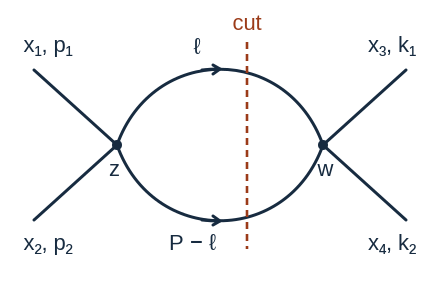
Read the solid lines first as position-space contractions. The two arcs give the square of the propagator between and . The external positions specify the channel . The arrows assign momentum flow for the next calculation. The dashed line crosses the two propagators that must go on shell together for a physical cut.
Count the automorphisms of a diagram
Write for the number of interaction vertices, for the internal lines, and for the independent cycles of a connected graph. The two-loop vacuum figure-eight in the normalized expansion has three slot pairings, two self-loops, and one vertex. Its contribution before vacuum normalization is
The automorphism group has elements: flip either loop and exchange the two loops. This source-independent term cancels from a normalized correlator, but it remains part of the unnormalized vacuum functional.
For the sunset, attach one labeled external field to each of two vertices. Assign the vertices in two ways, choose one of four slots at each, then match the remaining triples in ways. This gives 192 contractions and coefficient . The automorphisms permute its three parallel internal lines. Its two-loop routing uses two independent momenta.
The commonly drawn graph with two quartic vertices joined by four lines is different. It has , not two. Its pairings and expansion denominator give ; graphically the four lines may be permuted and the two unmarked vertices exchanged, giving . Keeping vertex count and loop count explicit prevents a mislabeled example from supplying the wrong coefficient.
| Graph with fixed external labels | ||||
|---|---|---|---|---|
| Two-point tadpole | 1 | 1 | 1 | 2 |
| Four-point bubble, one channel | 2 | 2 | 1 | 2 |
| Two-point sunset | 2 | 3 | 2 | 6 |
| Vacuum figure-eight | 1 | 2 | 2 | 8 |
| Four-line vacuum graph | 2 | 4 | 3 | 48 |
The tadpole’s surviving factor comes from flipping the ends of its self-loop. Its amputated two-point insertion is . The companion program enumerates both labeled pairings and graph automorphisms for all five rows.
Route and cut the same bubble
Keep the external labels in the figure and use physical scattering momenta into and out of . Strip the overall momentum-conserving delta and amputate the external propagators. Total momentum enters the two arcs. Choose on the upper arc from to . The delta at forces on the lower arc in the same direction. Thus
Each propagator includes its numerator . This virtual loop needs an ultraviolet regulator in four dimensions. The and channels have different external partitions. The two vertex delta functions show why one independent integration variable remains.
Now read the dashed line as a cut from the incoming to the outgoing side. Each crossed full propagator contributes , where and the arrow points from to . In the rest frame of these constraints set and , with . The cut is possible for and has zero phase-space volume right at threshold. The energy-contour derivation gives the discontinuity with its overall sign.
For the integrated labeled two-body phase space is . The cut is the product of two tree amplitudes times that phase space with the symmetry coefficient already found:
For example, gives . This also follows by summing over unordered two-scalar intermediate states in unitarity. The two computations count the same states once.
What connectedness does and does not remove
For the centered, invariant vacuum, the full four-point function includes
Every product on the right survives vacuum normalization: every component has external fields. The logarithm of the normalized source functional selects , whereas division by its zero-source value removes only vacuum components. This distinction is also made by the explicit diagram expansion in Tong, §3.7.1, where “connected” in that discussion means connected to at least one external leg.
A graph is one-particle irreducible, or 1PI, when cutting any one internal propagator cannot disconnect it. The four-point bubble is 1PI: one of its two internal lines remains after the other is cut. A connected six-point tree formed by joining two quartic vertices has one internal line and is one-particle reducible. Its exchange pole still belongs to the six-particle scattering amplitude. Amputation removes external propagation, not physical internal exchange.
External self-energy insertions also occur in the connected four-point correlator at second order. They are not additional proper four-point vertices. Organizing the correlator with full external propagators separates these attachments from its amputated kernel; external-leg residues then supplies the pole overlaps. The three bubble graphs alone are not a complete renormalized one-loop prediction without the relevant counterterms and external normalization.
A finite check that includes external dressing
A single real variable gives a useful check without a divergent integral. Use the normalized Euclidean weight , with . Its Gaussian moments are . Expanding both numerator and denominator gives
With every free covariance equal to one, the three bubble channels contribute . A first-order tadpole on any of the four external legs contributes another . Their sum is . Using only the bubbles would miss the external dressing of the connected unamputated cumulant. The companion program checks the matching counts separately from direct quadrature of this integral; neither calculation evaluates a continuum loop integral.
Identical final particles are a different quotient
For two identical final scalars, the labeled amplitude contains the sum of all appropriate channels. It is not divided by . If the final phase-space integration covers both and , then
Here . One may instead integrate over a region containing one representative of each unordered pair and omit the factor. Applying both prescriptions would undercount. This quotient counts final states after squaring a complete amplitude; counted internal contractions before squaring. Interference between channels remains.
For the tree quartic contact, has no graph divisor. Full labeled phase space gives a factor , not . Flux and detector cuts are additional ingredients developed in two-body scattering.
Summary
Labeled external fields fix which channel a graph represents. Pairings of identical internal slots determine its symmetry coefficient before any momentum integral is evaluated. In the four-point example the two parallel lines give a graph factor . Cutting those same lines recovers the sum over unordered intermediate states.
Exercises
Partition six labeled external legs
In the connected six-point quartic tree, keep one unordered partition of the six external labels into two triples. Count its contractions and its coefficient. How many such partitions occur?
Solution
Assign the two triples to the integration vertices in two ways. At each vertex the three labeled external fields occupy slots in ways; the remaining slots must join. Division by gives . There are partitions. Each contributes two vertices and one exchange propagator, and cutting that propagator disconnects the tree. Its symmetry coefficient is one, while its pole is retained by LSZ.
Subtract the disconnected moment
In the finite integral, what goes wrong if one subtracts the free value from instead of subtracting ?
Solution
The result would be rather than the connected cumulant. The omitted subtraction is . Those terms are products of corrected two-point components, all of which have external attachments and survive division by the vacuum denominator.
Count two different species
Replace the quartic interaction by , with distinct real fields. Find the coefficient of the two-point bubble made from two vertices and two parallel lines.
Solution
There are two assignments of the external legs to the vertices and bijections between their slots. Dividing by the expansion factor and the two vertex factors gives . The sole nontrivial graph automorphism exchanges the two lines; it cannot exchange a with a . The factor is under the loop integral.
Repeat a vacuum component
Take two disconnected copies of the one-vertex vacuum figure-eight. Find their total coefficient at order , and explain why the graph has four loops.
Solution
Each component has symmetry order eight, and exchanging the identical components adds . Thus , with coefficient . Directly, each vertex has three internal pairings, giving . Since , and there are components, . This is the quadratic term in exponentiating the connected vacuum contribution, not a new connected vacuum graph.
References
- Mark Srednicki, Quantum Field Theory, 2006 author draft, §9, Eqs.(9.6)–(9.16), especially the repeated-component factorial. His metric and propagator notation differ from ours.
- David Tong, Quantum Field Theory, §3.5.3 and §§3.7–3.7.2, for the quartic vertex and normalized correlators.
- Roman Zwicky, A brief Introduction to Dispersion Relations and Analyticity, §4.3, Eqs. (55)–(57), on the physical cut. Author’s lecture notes
Scrollable formula. Use Left and Right arrow keys to reveal hidden content.
Scrollable table. Use Left and Right arrow keys to reveal hidden columns.
Scrollable figure. Use Left and Right arrow keys to reveal hidden content.