Holographic Entropy Formulas
At leading order in a semiclassical Einstein-gravity dual, the entropy of a boundary region is
is a bulk spacelike codimension-two surface anchored on and homologous to . Homology requires a bulk region with boundary . The area is positive: in the site's mostly-minus metric the positive induced metric on a spacelike surface is minus the pulled-back spacetime metric. A boundary UV cutoff and the corresponding bulk radial cutoff must be specified.
Which surface is selected?
On a static or time-reflection-symmetric slice, the Ryu–Takayanagi prescription minimizes area among homologous surfaces on that slice. In a time-dependent spacetime, the Hubeny–Rangamani–Takayanagi prescription requires extremality in both independent normal directions. Subject to the applicable homology and causal conditions, one selects the smallest-area admissible extremal surface in the classical saddle prescription.
A Lorentzian extremal surface is generally a saddle of area. Minimizing over all spacelike surfaces in the entire spacetime is not the HRT rule. For disconnected regions or mixed states, homology can require disconnected surfaces or horizon components; anchoring alone does not choose the answer.
The interval check
For the vacuum of a two-dimensional holographic CFT on the line, use the slice of Poincaré ,
An interval of boundary length has geodesic .
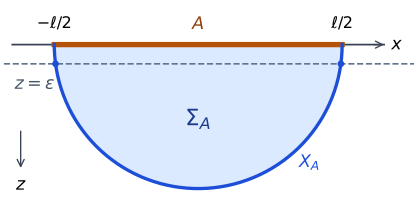
The interval and geodesic bound on the static slice. The dashed line marks ; the blue points are intersections with the boundary-anchored geodesic. This is a coordinate diagram: proper lengths use the AdS metric.
Cutting off this boundary-anchored semicircle at gives
The exact regulated length refers to the intersections with that same semicircle, not to fixing the endpoint separation at the cutoff surface. The logarithmic coefficient is unchanged by this distinction. The divergent entropy itself depends on the regulator; the universal logarithmic coefficient matches the CFT result.
Two intervals and the mutual-information threshold
On the vacuum line of a two-dimensional CFT with a classical Einstein AdS dual, take , with . Write and . Comparing the two homologous geodesic pairings gives
The connected bulk region wins for . For equal interval lengths and gap , , so the exchange occurs at . At larger gaps the order- mutual information vanishes. Bulk quantum correlations can still contribute at order one. Derive the two competing entropies · Headrick, §4.2, Eq. (42).
Quantum extremality
At semiclassical orders beyond the leading area term, the generalized entropy is
The variation is in the two normal directions. includes the area and the geometric terms required by the gravitational effective action; is the entropy of the chosen bulk region or algebra, in the specified bulk state. Their regulator-dependent terms must be renormalized consistently. Gauge fields require an explicit algebra or edge prescription.
The quantum-extremal-surface prescription selects the relevant extremum by the semiclassical saddle comparison, using the smallest generalized entropy when one saddle dominates. Near competing saddles, a single sharp minimum can miss finite-order effects.
Derivations and sources
See Ryu–Takayanagi surfaces, covariant holographic entropy and quantum extremal entropy. For the boundary quantity and its UV restrictions, see entropies.
- Ryu, S., and Takayanagi, T., “Holographic Derivation of Entanglement Entropy from AdS/CFT,” arXiv:hep-th/0603001v2, §§II–III for the minimal-area proposal and interval check.
- Hubeny, V. E., Rangamani, M., and Takayanagi, T., “A Covariant Holographic Entanglement Entropy Proposal,” arXiv:0705.0016, §3.3 and Appendix B for extremality.
- Engelhardt, N., and Wall, A. C., “Quantum Extremal Surfaces,” arXiv:1408.3203v3, §3, Eq. (3.1), for generalized entropy and competing extrema.
Scrollable formula. Use Left and Right arrow keys to reveal hidden content.
Scrollable table. Use Left and Right arrow keys to reveal hidden columns.
Scrollable figure. Use Left and Right arrow keys to reveal hidden content.