Bordisms, State Spaces, and Gluing
Cut a closed surface along a circle. Each piece has a boundary state, and sewing the pieces back together contracts those states. A topological field theory makes this rule precise: a bordism gives a linear map, consecutive bordisms compose, and disjoint systems tensor together. The topology specifies which contraction to perform. Compare the two oscillator amplitudes on cylinders of different lengths. Forgetting the metric makes the oriented cylinder an identity morphism and removes that length dependence.
We define the oriented bordism category and work through a two-state example. It distinguishes the identity cylinder from a surface with a handle and explains why orientation duality alone does not give a positive Hilbert-space inner product.
Preparation: Categories and functors and linear duality. No continuum path integral is assumed.
Specify the spacetime dimension and boundary structure
Fix a positive integer . The category has closed, compact, oriented smooth -manifolds as objects. A morphism is a compact oriented smooth -manifold with boundary identified as
The bar reverses orientation. Incoming boundary orientation is therefore opposite to that of its named object; outgoing boundary orientation agrees with it. Boundary collars are included so that gluing is smooth. Morphisms are identified under orientation-preserving diffeomorphisms compatible with the boundary identifications. Composition glues corresponding outgoing and incoming boundaries, and the identity is the cylinder .
Disjoint union is the symmetric monoidal product, with the empty manifold as its unit. A finite-dimensional complex oriented TQFT is a strong symmetric monoidal functor
In particular,
The tensor identifications are compatible with associativity, units and exchange of components. A closed -manifold is a morphism from the empty object to itself, so its value is a complex number. Here denotes spacetime dimension; Atiyah's original axioms, §2 (PDF), use a dimension convention shifted by one.
This is the unextended category: it assigns spaces to closed codimension-one manifolds and maps to bordisms. Points in two dimensions, corners and physical boundary conditions require an extended formulation. A spin or framed theory uses a different source category with that extra geometric structure and compatible gluing.
Turning an input into a dual factor
The oppositely oriented object is dual to in the bordism category. A cylinder can be regarded as a bordism from to the empty object, or as one from the empty object to . Applying gives evaluation and coevaluation. Their two snake composites are ordinary identity cylinders, so
where denotes the complex-linear dual. If and are dual bases, coevaluation is . Sewing contracts a dual factor with its partner.
Thus a bordism may equivalently be represented by a tensor in
No complex conjugation occurs in this identification. A conjugate-linear operation and a positive Hermitian form are additional data. Likewise, reversing the orientation of an entire spacetime does not, from the oriented-functor axioms alone, imply complex conjugation of its amplitude. Atiyah explicitly distinguishes this extra Hermitian condition after deriving the trace formula in §2, printed pp.180–181 (PDF).
A circle with two states
Now take . Choose an oriented circle and let
Assign the merging pair of pants to multiplication , a disk with outgoing boundary to the unit , and a disk with incoming boundary to the counit . Set
For nonzero complex numbers , set . The bilinear pairing obtained by merging two circles and capping is
Identifying oppositely oriented circle states with using this pairing, the splitting pair of pants must be
Indeed, pairing its outputs with gives , exactly the amplitude of three labels joined by one pair of pants. The cup is
Sewing one leg to an arbitrary gives
This is the identity-cylinder test. The inverse pairing, not the pairing itself, supplies the coefficients of the cup. The Frobenius classification will prove that these local assignments extend consistently to every oriented surface.
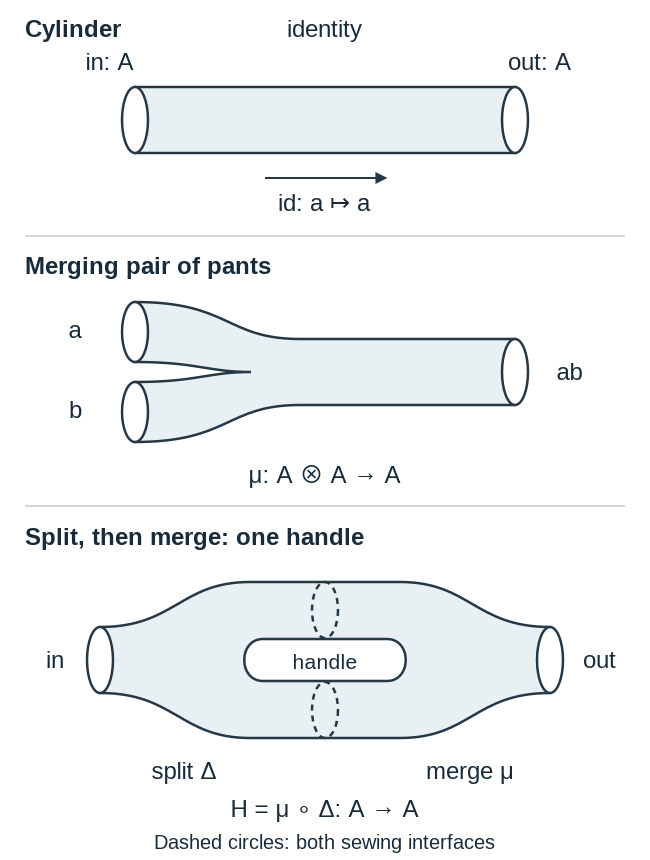
Read each schematic surface from left to right. The cylinder acts as the identity. A pair of pants multiplies two incoming states. Splitting one circle and merging the two outputs along both intermediate circles produces a genus-one bordism with two external boundaries, whose map is . It is not a cylinder. Dashed circles mark the two sewing interfaces; the drawing carries no metric or time scale.
A handle is not an identity evolution
Specialize to . Then , while
The split-then-merge surface has Euler characteristic : each pair of pants contributes , and gluing along circles changes neither contribution. It has two remaining boundary components, so gives . Topology therefore permits to differ from the cylinder identity.
For two incoming states and , pants multiplication gives
If these inputs are first merged, then split, the map is , a different bordism with four external boundaries. It sends to . Counting boundary components prevents confusing these two compositions.
Close a disk after attaching handles. The resulting closed genus- surface has amplitude
In particular the sphere, torus and genus-two values are , and . The finite gauge construction will obtain exactly these numbers by counting bundles with their automorphism weights.
Closing a cylinder gives a trace
There is another cut of the torus: identify the two boundary circles of an identity cylinder. Evaluation and coevaluation give
In the pairing basis above, the contraction is , independently of the nonzero . Agreement with the handle computation is a substantive sewing check; neither formula requires choosing an orthonormal basis.
More generally, gluing a mapping cylinder of an orientation-preserving diffeomorphism into a mapping torus gives . The identity cylinder has no length parameter in this category. Introducing a factor would require geometric data such as a time length, which are absent here.
Summary
An oriented bordism functor turns sewing into linear composition and disjoint union into tensor product. Orientation reversal supplies linear duality. The two-state example fixes its cup by the inverse pairing, passes the cylinder identity, and assigns a distinct handle map to a topologically distinct surface. Its torus amplitude is the trace of the circle identity.
Exercises
1. The wrong cup breaks the cylinder
For weights , replace the cup by . Compute the snake composite.
Solution
On the composite is . It is not the identity. Multiplying the cup by four restores the cylinder. The pairing and its inverse cannot be interchanged, even in a diagonal basis.
2. Unequal weights change handles but not the torus
Take and . Compute the handle eigenvalues and the sphere, torus and genus-two amplitudes.
Solution
The handle acts diagonally with eigenvalues and . The sphere is . The torus is . At genus two the result is . Equal circle dimensions determine the torus value, but not the sphere or higher-genus values.
3. A gluing pairing need not be positive
Let and . Does the cylinder test still pass? If conjugation fixes the two basis elements, is positive?
Solution
Both weights remain nonzero, so the inverse pairing exists and the snake composite is still the identity. But . The oriented algebraic theory therefore does not satisfy positivity with this conjugation. Its torus value is nevertheless two. Checking only a few positive-looking closed amplitudes cannot replace testing the actual state-space form; see orientation and reflection positivity.
References
- M. F. Atiyah, Topological quantum field theory (PDF), Publications Mathématiques de l'IHÉS 68 (1988), 175–186, §2, especially printed pp.178–181, for gluing, the cylinder, trace and additional Hermitian axiom.
- L. Abrams, Two-dimensional topological quantum field theories and Frobenius algebras (PDF), Journal of Knot Theory and Its Ramifications 5 (1996), 569–587, §§4–6, for surface operations and their algebraic classification.
Scrollable formula. Use Left and Right arrow keys to reveal hidden content.
Scrollable table. Use Left and Right arrow keys to reveal hidden columns.
Scrollable figure. Use Left and Right arrow keys to reveal hidden content.