NLO Matching, Merging, and Signed Weights
A next-to-leading-order calculation already contains one real emission. A parton shower also generates a first emission. Adding the two samples without subtracting their common approximation counts part of the same radiation twice. Matching removes that overlap while retaining the shower's repeated-emission evolution.
We derive the cancellation and test an actual photon-current process, at , with MG5_aMC@NLO and Pythia. The comparison keeps absolute rates, an infrared-safe event shape, signed weights and consistently regenerated matching-scale variations. It also exposes why a reasonable normalized histogram is insufficient evidence that an event file has been interpreted correctly.
Preparation: NLO subtraction, ordered showers and weighted phase-space events. We use unpolarized cross sections, natural units and the mostly-minus conventions.
What must cancel at first order
Let denote Born phase space and a real-emission chart with its appropriate Jacobian. Write for the Born differential cross section, for the real contribution, and for a local infrared subtraction term. The finite virtual contribution includes the integrated subtraction and renormalization terms. For an infrared-safe measurement ,
The map that defines in the real integral is part of the subtraction prescription. Infrared safety means that approaches that mapped in the unresolved limit; neither nor its counterterm need have a separately finite integral.
Let be the real-emission approximation generated by the selected shower. It includes its emission variables, recoil map, phase-space restrictions and starting scale. In a simple positive-kernel region, the shower's first-order expansion is
The negative term comes from expanding the no-emission probability. Equation (2) is a local schematic representation, with sums over emitting regions understood; a complete implementation must preserve their mappings and color structure.
Define a Born-like weight and a hard remainder,
The matched functional has the structure
In the second term, is already one order higher than , so suffices for an NLO expansion. In the first-emission term of the first integral, replacing by changes only the next order. The terms proportional to the shower approximation are then
What remains is precisely (1). This cancellation explains both the need for the hard remainder and the dependence of the subtraction on the chosen shower. It is a fixed-order statement through NLO, with the implementation's infrared resolution and power corrections understood; it does not prove arbitrary logarithmic accuracy or remove shower-model dependence. The concrete MC@NLO construction and shower-dependent restrictions are given in Alwall et al., §2.4.4, Eqs. (108)–(120).
For , unitary shower evolution gives . The integrals of cancel already in (3)–(4). The matched inclusive rate therefore retains the NLO normalization. At finite event count, its signed estimator fluctuates around that integral; it is not required to equal a separately estimated cross section digit for digit.
Matching is different from merging
Matching combines a given fixed-order multiplicity with its shower. Merging additionally combines samples with different resolved hard-parton multiplicities. Those samples overlap in regions where a lower-multiplicity shower can produce an extra jet, so merging requires a resolution prescription and another subtraction or veto construction. A matching starting scale and a merging separation scale answer different questions.
The calculation below uses one inclusive Born process at NLO, ordinary MC@NLO, and ickkw=0. There is no FxFx merging. Adding an independent event sample to it would not automatically improve the result: the already generated radiation would overlap. The distinction and the additional FxFx construction are described in Alwall et al., §2.4.5.
Likewise, a matched LHE hard-event file before showering is not a substitute for an ordinary fixed-order distribution. Its Born-like and hard weights have been rearranged using ; the first-emission contribution needed in (5) has not yet been generated. Our fixed-order reference is a separate native NLO integration, not a histogram of that unshowered matched file.
A common infrared-safe event shape
In the centre-of-mass frame define the normalized momentum tensor using all final QCD partons,
Zero-momentum slots are omitted. The tensor is positive semidefinite and has trace one. If its eigenvalues are , then , with . A back-to-back pair gives and . Three equal-energy momenta separated by give and .
A collinear split leaves both tensor numerator and denominator unchanged. Adding a momentum of magnitude changes them continuously by away from an empty event. Thus this measurement is infrared and collinear safe. With three massless partons the event is planar, so ; larger values require higher multiplicity. The same spatial-momentum definition is used after showering, even when the shower retains its specified small kinematic masses.
There is a useful absolute normalization check beyond the total rate. For the massless nonsinglet electromagnetic current,
where and . To test the event shape itself, put , with . Momentum conservation in (6) yields
Multiplying this by the exact three-parton real-emission kernel cancels its soft-collinear denominators. With , , the Jacobian is and the triangle becomes a unit square. Integrating over gives
Use , together with the integrals , and . Therefore
Born and virtual terms have , so no additional virtual constant enters this moment. Dividing (10) by gives the ratio normalized to the unexpanded NLO total; that ratio convention differs from a consistently re-expanded series only beyond this order. The companion independently integrates the two-variable real kernel and checks (8) against actual momenta, rather than reusing the final constant as its numerical integrand.
The actual generator setup
The retained calculation uses the official MG5_aMC@NLO 3.8.1 release, Pythia 8.317 and HepMC 2.06.09. It generates
import model loop_sm-no_b_mass
generate e+ e- > u u~ / z [QCD]
This is a declared photon-mediated current, excluding Z exchange, with one Born, two real and one virtual diagram. It is not the complete electroweak prediction. Both unpolarized beam energies are , there are no PDFs or final-state generation cuts, and . The hard calculation uses , , two-loop running and fixed . Its actual recorded coupling is ; inserting directly into (7) or (10) would test the wrong scale.
The native loop calculation uses CutTools and IREGI, including its default stability/rescue settings. Matrix-element and MC-counterterm tests passed, as did pole cancellation at all 20 tested points with tolerance . These local tests are useful checks of the generated implementation, not a replacement for the normalization and observable comparisons.
For the partonic shower, ISR, MPI, hadronization, QED and weak radiation, primordial transverse momentum and shower matrix-element corrections are disabled. The official MC@NLO global-recoil prescription is retained. Pythia uses one-loop shower running with , no CMW rescaling, transverse cutoff , and its specified quark masses . These shower choices differ from the massless fixed-order approximation in controlled, stated ways; the comparison is not a hadron-level prediction. The necessity of retaining the matching-specific recoil and first-emission settings is explicit in the official Pythia 8.317 manual, “aMC@NLO Matching,” and its “Matching and Merging” section on MC@NLO. Manual.
Four independent NLO integrations request inclusive accuracy . For each matching factor , four independent matched samples contain 10,000 hard events apiece. All counts and seeds were fixed before production. Changing shower_scale_factor changes the generated MC-subtraction restrictions as well as the hard-event shower scales, and every scale sample is regenerated. We do not edit only SCALUP in an existing file. Kinematic bounds may limit the effect of an increased starting scale; variation factors do not promise a proportional change of every shower.
Signed events and what their errors mean
Neither nor is guaranteed positive. A negative event is a negative contribution to an estimator, not a negative probability for an observed collision. If is an event weight in pb and selects a bin,
Dropping negative events changes both quantities. A cancellation diagnostic often quoted is
It is not a universal effective sample size for every observable: the location and correlation of positive and negative contributions matter.
Our actual files require an additional convention check. The LHE files use signed-unweighted strategy with a common absolute event weight. The native Pythia83 HepMC wrapper records signs, although its generic comment describes cross-section-normalized weights. The reader verifies the complete LHE/HepMC counts and sign sequences, then multiplies each shower sign by that run's actual LHE weight magnitude in pb. It does not use the wrapper's cumulative cross-section field or force the finite signed sum to equal the native integration estimate. All generated events must pass the declared guards; an incomplete sample is rejected for investigation, not silently rescaled.
For fixed-order histograms, the native HwU integrator preserves correlations between a real event and its subtraction counterevents. Treating those counterevents as independent observations would give a different variance. The first C bin includes the Born point, virtual terms and unresolved subtraction, and can be negative at fixed order where large Sudakov logarithms spoil the truncated distribution.
Displayed uncertainties use the scatter of four independent complete run estimates: , with only three variance degrees of freedom. Normalized quantities are formed within each run before averaging, retaining numerator–denominator covariance. This includes fluctuations of the integration-derived normalization, signed event selection and shower evolution in the matched case. Native integration errors and an iid-event covariance diagnostic are also retained separately. The latter treats the event vectors as independent and identically distributed, holds the common weight magnitude fixed, and omits its integration uncertainty. It is not a proven covariance formula for a native channel allocation that may introduce stratification or correlations. Four replicas give a useful, noisy uncertainty estimate, not a coverage guarantee; ratios also have finite-sample bias.
Fixed-order and showered results
The four fixed-order runs give and . Equations (7) and (10), using the generator's conversion from to pb, give and . The separate Born reference is . These comparisons check an absolute cross section and a nontrivial measurement; neither depends on rescaling a histogram to unit area.
All 120,000 matched hard events were showered and retained, with complete sign correspondence and final-state four-momentum conservation. EOF messages in the native wrapper were distinguished from physical shower failures. The realized signed total is therefore preserved by showering in every run. The primary independent-replica summaries are:
| Calculation | Signed total [pb] | C moment [pb] | Mean C |
|---|---|---|---|
| Fixed NLO | |||
| NLO+PS, | |||
| NLO+PS, | |||
| NLO+PS, |
The signed rate lies below the analytic NLO rate, about 7.2 times its observed four-run standard error. That is not a Gaussian “seven-sigma” result: there are only three variance degrees of freedom, and the four realized rates cluster unusually tightly. The separate iid-event diagnostic gives conditional standard errors of about – for each run, or for their mean, before integration-normalization uncertainty. The native integration errors combine to for their mean; these separate diagnostics are appreciably larger than the observed scatter.
For that same scale, the mean native integrated rate is ; finite signed-event selection changes the realized mean by . This miss remains in the result. It neither establishes a failure of matching unitarity nor justifies renormalizing the events or replacing seeds. Complete correspondence before and after showering verifies preservation of each realized sample, a distinct statement from statistical agreement with the integral.
The negative-event fractions are , and at . Their dependence on the matching choice is expected because the division into and changes. It is not a probability of producing an unphysical collision.
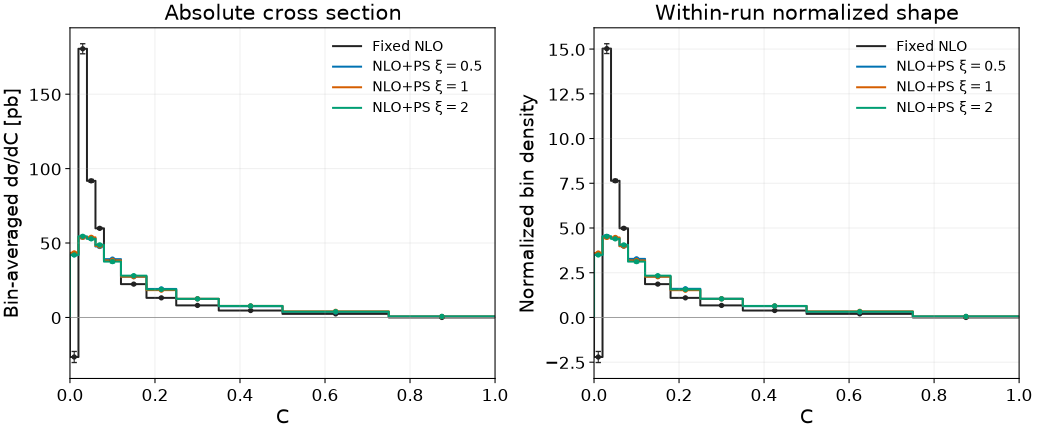
The same fixed nonuniform C bins are shown as bin-averaged densities. Left: absolute cross sections. Right: each run is normalized by its own signed total before the four ratios are averaged. Error bars are the standard errors across four independent runs. The matching factors use independently regenerated samples. Negative fixed-order bins are retained, and no band is interpreted as a complete theory uncertainty.
The fixed-order first-bin integral, , is . At central matching scale it is . A negative fixed-order bin does not contradict positivity of physical cross sections: the logarithmically enhanced truncated expansion is unreliable there. The shower reorganizes unresolved and repeated emissions, while matching fixes the first-order overlap. This example does not by itself establish next-to-leading-logarithmic accuracy.
Away from the first bin, central matching gives , compared with at fixed NLO. Multiple emissions also populate , where the massless three-parton NLO distribution vanishes. Such changes are higher-order shower effects and include the declared regulator/model choices; NLO matching does not require the unexpanded results to coincide numerically at physical coupling. The moment's shift is substantial and should remain visible, not be concealed by discussing only the inclusive rate.
The and means are statistically close at these budgets; has a somewhat smaller C moment. The three choices are a bounded matching-scheme sensitivity study. They do not bound omitted perturbative orders, substitute for a renormalization-scale variation, or constrain the absent hadronization model.
Reproduce the comparison and preserve its scope
The companions are under examples/computational-qft/event-generation/. MATCHED-RUNTIME.md gives the exact official releases, local dependency build, process generation, native analysis selection and frozen production command. matched-software.json retains source URLs/checksums, compiler/runtime choices and the unsuccessful preliminary setup attempts. Upstream software is not bundled with the article.
analysis_HwU_C.f is the original fixed-order analysis; matched_observables.py implements the same C tensor and strict event readers. matched_checks.py verifies the Born, Mercedes, isotropic, rotation, collinear and soft controls. The independent real-emission integral agrees with to in this calculation. run_matched.py regenerates the declared independent samples; summarize_matching.py and plot_matching.py only summarize or plot completed results. No solver, event generation or external installation is needed to read the static page.
The selected JSON includes every run estimate, native integration and histogram errors, the explicitly approximate iid-event covariance diagnostic, signed counts, failures and settings. One parser guard initially rejected an already completed FO run because the native Fortran histogram has seven significant digits, although a later formatter prints eight. The corrected check uses the sum of the fields' rounding bounds, and reparsed that same output without redrawing events. None of the physical acceptance or weight guards was weakened.
Summary
NLO matching subtracts the selected shower's first-emission approximation from the hard remainder and restores it through shower evolution. Signed events are part of this cancellation and must retain their actual units and correlations. The real MG5/Pythia comparison checks the inclusive rate, an analytically calculable C moment, absolute and normalized distributions, and regenerated matching-scale changes. Its finite-event misses, small-replica uncertainty and specified shower regulator remain part of the result.
Exercises
1. Change the shower without changing the subtraction
Suppose the hard samples still use in (3), but the shower's first-emission kernel is changed to , where is of order and has finite relevant integrals. Derive the resulting first-order bias. Can the total rate still pass its check while a C distribution fails? Give the compensating changes that restore the cancellation.
Solution
The changed Born shower adds
Changes in showering the hard remainder begin one order later, so they cannot remove this first-order term. For , it vanishes identically: normalization alone cannot detect the mismatch. For the C moment, and the bias is , generally nonzero. The same conclusion holds for a bin indicator whose real and mapped Born values differ.
A consistent matching change uses
Their changes contribute at first order, canceling the shower change. This is why changing a hard-file starting scale alone is not the matching-scale experiment specified above. A formal change in support or recoil also changes the definition of the integrals and mapped measurements; it cannot be represented by a numerical scale factor while ignoring its subtraction map.
2. A signed sample and a correlated ratio
Four independent proposals have weights . Their bin-A indicators are . Compute the signed total, bin rate, normalized fraction and . What happens if the negative event is deleted? Treating the common weight magnitude as fixed, calculate the sample covariance of the estimated bin rate and total, and the delta-method variance of their ratio. Explain the limitation of that last number for so few signed events.
Solution
The total is , the bin estimate is , and . Since , the cancellation diagnostic is . Deleting the negative event gives and , hence ; it changes the rate and shape.
Let . For four independent proposals, the sample estimate of the covariance of their sum is
The gradient of at the observed sums is . Therefore
Omitting the covariance would instead give , a different answer. Neither value supplies a trustworthy probability interval in this tiny example: signed denominators can approach or reach zero in other realizations, and a first-order ratio expansion need not describe the resulting distribution. The calculation demonstrates covariance bookkeeping, not a general Gaussian error law. If the weight magnitude is itself estimated by an integration, its uncertainty is an additional ingredient, as in the actual production study.
References
- J. Alwall et al., “The automated computation of tree-level and next-to-leading order differential cross sections, and their matching to parton shower simulations,” Journal of High Energy Physics 07 (2014), 079, arXiv:1405.0301v2. §§2.4.4–2.4.5, Eqs. (108)–(120), and §3.2 supply the matching, merging and runtime distinctions. Article.
- MadGraph5_aMC@NLO collaboration, version 3.8.1 official release. Inspected implementation:
Template/NLO/FixedOrderAnalysis/analysis_HwU_template.f,SubProcesses/montecarlocounter.f, the Pythia83 HepMC driver and generated run/shower cards. Exact archive and checksum are retained with the example. Official release. - Pythia collaboration, Pythia 8.317 HTML Manual (2026), “aMC@NLO Matching,” “Matching and Merging,” and “Timelike Showers.” The passages and defaults were inspected in the official 8.317 release archive; the online manual may reflect a later release. Matching manual, release archive.
Scrollable formula. Use Left and Right arrow keys to reveal hidden content.
Scrollable table. Use Left and Right arrow keys to reveal hidden columns.
Scrollable figure. Use Left and Right arrow keys to reveal hidden content.