Reading the Three-Dimensional Ising Bootstrap Island
How can three four-point functions constrain the correlation length of a three-dimensional magnet? Read the published Ising island of Kos, Poland, Simmons-Duffin and Vichi (2016). Its two plotted coordinates are scaling dimensions. Turning them into magnetic and thermal exponents lets us compare the exclusions from conformal crossing with a measurement on finite lattices.
Use a unitary three-dimensional CFT with a global spin-reversal symmetry . Take to be the leading odd scalar and the leading nonidentity even scalar. Assume these are the only relevant scalars in their respective sectors and that each is unique at its own dimension. A scalar is relevant when . Other operators obey the appropriate unitarity bounds. The crossing problem uses the three correlators of the types , , and . The assumed gaps and the shared operator data are inputs to the island. Kos et al., §2.1, Eqs. (2.1)–(2.5), and Fig. 1
Project the mixed-correlator constraints
Choose unit two-point normalization for both external fields. An even operator appears with a vector of real OPE coefficients
Its contribution to the crossing equations is linear in the positive semidefinite matrix . If several operators of identical dimension and spin contribute, the sum of their matrices can have rank two. For our unique the matrix has rank one. Moreover, permutation symmetry identifies the odd-channel three-point coefficient with . The mixed-correlator construction derives these positivity conditions.
At a trial pair , write . For fixed the positive scale multiplies one specified direction in the crossing equations. An exclusion functional acts positively on the identity and nonnegatively on every allowed nonidentity contribution, including the shared leading direction. Acting on an exact crossing sum would then give a strictly positive result where zero is required. Such a functional excludes that triple. The authors search for functionals made from derivatives up to a finite order .
The plot projects out . A pair of dimensions survives if there is some direction for which the numerical search does not exclude it. Excluding a pair requires excluding every admissible direction. Searching only at the best-fit angle could discard a pair that survives at a different ratio. Conversely, finding no separating functional in a finite search does not construct a complete CFT at the retained point. The finite navigator example shows how a computational representation can change a boundary.
Read the published projection
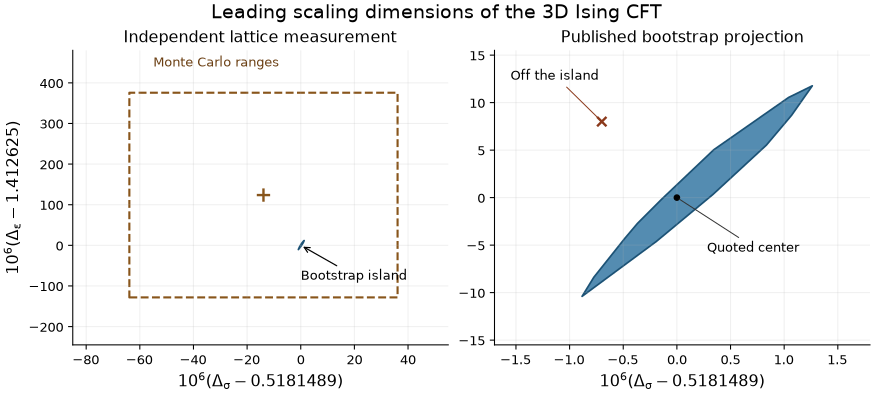
Both panels show the same projection at derivative order 43. The axes give displacements from the authors' quoted center in millionths. Left, the rectangle shows the two separate lattice error ranges. Right, the tilted blue outline follows the published inset. Outline adapted from Kos, Poland, Simmons-Duffin and Vichi, Figure 1. QFT.org recalibrated the printed vector path, redrew the axes and added the marked test point. The paper describes its curve as a fit to computed points. Published figure and calculation · CC BY 4.0
Read across the axes before assigning independent ranges. The pair is inside both one-coordinate ranges quoted below but lies off the narrow tilted region drawn in the paper. This graphical test demonstrates information lost in a projection onto each axis separately. It supplies no new functional at that test point. For precision, use the authors' published numbers, not coordinates measured from the illustration.
At the paper reports
The parenthetical widths are and . They summarize the projected numerical region under the declared assumptions. There is no frequency distribution of theories in the blue area and no confidence probability attached to its center. The quoted OPE ratio at this order is . The paper uses a separate magnitude calculation at when quoting absolute leading OPE coefficients. Kos et al., §3, Eqs. (3.1)–(3.5) and notes 2–3, and Appendix A
Convert two dimensions to critical exponents
At the critical point a spin correlation falls as . Its magnetic scaling definition is . A reduced-temperature deformation couples to , so its RG eigenvalue is . Rescaling by a factor that makes this coupling order one sets the correlation length . In ,
The quoted island gives and . The temperature exponent increases with , so applying the reciprocal to both ends of the reported dimension interval gives the ordered range to the shown precision.
Hasenbusch simulated the three-dimensional Ising and Blume–Capel lattice models and used finite-size slopes and susceptibilities to estimate and . For example, at criticality the susceptibility grows as , and the thermal slope of a dimensionless ratio grows as up to corrections. These measurements constrain the same leading scaling dimensions assuming Ising universality. Hasenbusch, finite-size measurement · Derivation of the measured powers
| Quantity | Mixed-correlator study, 2016 | Lattice study, 2010 |
|---|---|---|
Both island centers fall within the respective lattice ranges. The two methods have different sources of uncertainty. The bootstrap conclusion depends on the allowed spectrum, the functional search and its numerical control. The simulation requires equilibration, a critical-point estimate and extrapolation across finite boxes. The rectangle uses the two separate lattice uncertainties. A joint confidence contour would require information about their covariance and how the systematic errors enter.
Reproduce the figure reading
The companion at examples/cft/ising-bootstrap-island/ retains the calibrated outline, the two studies' scalar inputs, and the plotting and verification programs. It reconstructs the figure geometry independently from both the overview and the magnified inset of the published vector PDF. The article's numbers come directly from the reported estimates. The companion checks the test point, the projected ranges and the exponent conversion; a new crossing solve would require the functional basis, positive-block approximations, spin treatment and numerical settings of the original computation.
Exercises
1. Which angle must be excluded? Two trial OPE ratios tested at one pair of dimensions both admit exclusions. A third ratio admits no separating functional in the same search. What may one conclude about the pair and the projection?
Solution
The two exclusions each rule out a triple with its specified ratio. The third ratio still supplies a candidate at this pair of dimensions for the chosen search. As the projected set is the union over all ratios, the tested failures do not exclude the pair. Failure to separate at the third ratio also fails to establish the existence of consistent higher-point data or of a local CFT. A finer search could still exclude it.
2. Propagate the lattice errors. Starting with and , work out the two dimension ranges. Why would translating these error widths into a probability for the bootstrap island require additional assumptions?
Solution
The spin dimension is , giving . The energy dimension is and increases with . The two endpoints at and give and , around a central . The quoted exponents supply marginal uncertainties. Neither their joint statistical distribution nor a probability measure on bootstrap solutions follows from these transformations.
References
- F. Kos, D. Poland, D. Simmons-Duffin and A. Vichi, “Precision Islands in the Ising and O(N) Models,” JHEP 08 (2016) 036. Figure 1 and §3 give the projection and quoted dimensions. Section 2.1 and Appendix A specify the OPE-direction scan and boundary search. Published article
- M. Hasenbusch, “Finite size scaling study of lattice models in the three-dimensional Ising universality class,” Physical Review B 82 (2010) 174433. Sections VIII–IX give estimates of the magnetic and thermal exponents from finite-size scaling in improved lattice models. Author manuscript
Scrollable formula. Use Left and Right arrow keys to reveal hidden content.
Scrollable table. Use Left and Right arrow keys to reveal hidden columns.
Scrollable figure. Use Left and Right arrow keys to reveal hidden content.