Sine-Gordon Theory
A periodic scalar potential supports more than small oscillations. A field can interpolate between neighboring minima and carry an integer topological charge. Sine-Gordon theory makes that kink explicit, while its quantum version connects solitons to fermions through bosonization.
Classical defining data
In -dimensional Minkowski space take a real scalar with
The field and have zero engineering dimension. We initially treat as real-valued with distinct boundary vacua . A compact target identification requires specifying the allowed winding sectors. Small oscillations about a minimum have classical mass ; it is not automatically the exact quantum particle mass.
The equation of motion is
Integrating the kink equation
For a static configuration joining to , multiply the second-order equation by . The boundary condition sets its first-integral constant to zero:
For the increasing solution,
Separating variables gives
The constant is the center. Since the two energy terms are equal on this solution,
The conserved topological current and charge are
For , this kink has . Conservation follows from commuting derivatives for smooth fields, without using the equation of motion. A Lorentz boost gives a moving kink with energy .
Quantum relevance and the fermionic point
The quantum cosine must be defined as a renormalized vertex operator at a specified scale. Around the canonical Gaussian fixed point it has dimension
It is relevant for . At , the corresponding massive Thirring coupling vanishes in the vector-current prescription, so the local theory admits a free massive Dirac description. The fermion number current is the negative of the topological current defined above in the site's bosonization orientation. Calling the two charges “equal” without fixing that orientation would lose a sign.
Predict the neutral spectrum from a current coupling
Choose in the Thirring current convention. It gives . Let be the physical soliton mass and set . In the attractive regime , the exact soliton–antisoliton scattering solution gives neutral bound states with masses
Here . The first neutral particle has mass , the second has mass , and lands at the two-soliton threshold. Only the first two are isolated bound states. In particular a mass measurement alone cannot distinguish the first breather from a charged soliton at this coupling. The winding charge can. These are quantum mass ratios. The classical kink calculation gives the leading soliton mass only at weak . Pole derivation and source conventions.
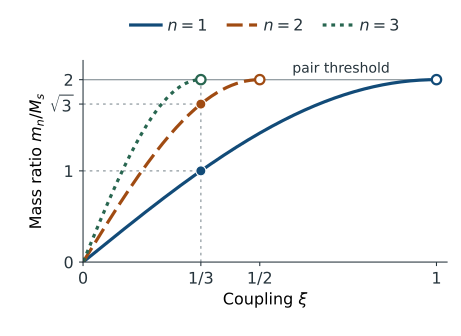
First three breather masses in units of the physical soliton mass. Each open endpoint marks the two-soliton threshold . At the filled points give and .
Exercise
Show that the kink has a translation zero mode and that its squared norm equals the classical kink mass.
Solution
Differentiate the static field equation with respect to . The fluctuation operator is
The mode is the change produced by shifting . Its norm is by the first integral. Consequently a slowly varying center has kinetic energy , matching the expansion of the relativistic kink energy.
References
Sinh-Gordon theory replaces the periodic potential by a single-well exponential potential, removing the vacuum interpolation used here. The Thirring model supplies the fermionic interpretation and its coupling dictionary.
- Sine-Gordon–Thirring duality, for the current normalization, operator dimensions and quantum sectors.
- Sidney Coleman, Quantum Sine-Gordon Equation as the Massive Thirring Model, for the quantum equivalence in a specified renormalization prescription.
- P. Dorey, Exact S-matrices, §§4–5, for the sine-Gordon poles and bound-state interpretation. His coupling parameter equals here.
Scrollable formula. Use Left and Right arrow keys to reveal hidden content.
Scrollable table. Use Left and Right arrow keys to reveal hidden columns.
Scrollable figure. Use Left and Right arrow keys to reveal hidden content.