Roots, Weights, and Highest-Weight Modules
A multiplet contains more information than its dimension. Its commuting charges label the states, while the other generators move between those charges. For an triplet, three charge pairs form a triangle. For the adjoint octet, six nonzero charge pairs form a hexagon, and two independent states occupy its center. Roots and weights explain both pictures and the allowed transitions between them.
Preparation: Matrix Lie groups and their algebras and finite-dimensional representations. We study finite-dimensional complex representations of compact groups and their complexified Lie algebras. Infinite-dimensional highest-weight modules require additional qualifications.
Commuting generators and the metric on charge space
Use the site's Hermitian generators, with and . A convenient commuting pair is
Their span is a Cartan subalgebra in the Hermitian description. The mathematical compact algebra consists of anti-Hermitian matrices ; after complexification we may use the diagonal matrices above and the off-diagonal matrix units .
A simultaneous eigenvector has and eigenvalues . Throughout this article its weight coordinates are
This declared Euclidean metric makes the roots have squared length two. In the unscaled coordinates their squared length would instead be one. The scale affects coroot formulas and must accompany a weight diagram.
For the standard basis vectors of the defining representation, the weights are
They sum to zero, as expected from the traceless generators. These are the three weights of the fundamental representation. Below, the phrase fundamental weights will denote a different object: a basis of the weight lattice.
Roots are the charges carried by generators
For any diagonal matrix ,
Thus has adjoint weight . The six nonzero adjoint weights are the roots. Choose simple roots
The positive roots are , , and ; the other three are their negatives. Their Gram matrix is
For this equal-length root system it is also the Cartan matrix, whose general entry is .
If has weight , the commutator immediately gives
Consequently , when nonzero, has weight . A root is a possible step in charge space, not a guarantee that every state can take that step. In the triplet, for example, but . See Hall, Chapter 6, Definitions 6.3 and 6.7 and Lemma 6.8 (PDF) for the general weight-shift statement.
The adjoint also contains the two independent diagonal traceless matrices. They commute with the Cartan subalgebra and therefore both have zero weight. Counting six roots and these two states gives dimension eight. Zero is an adjoint weight, but it is not called a root.
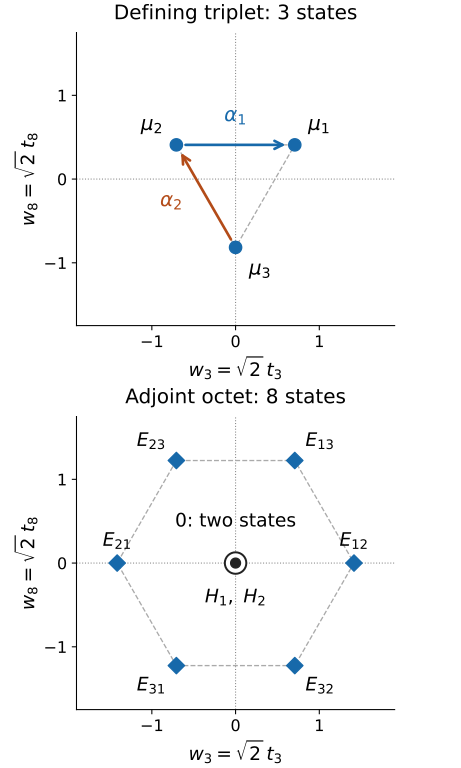
The defining triplet and adjoint octet, with and roots of squared length two. Arrows in the upper panel show the simple-root transitions. The two concentric markers at the lower center denote multiplicity two at the same weight; they do not denote two separated weights. All positions follow from the diagonal generators above.
Each simple root supplies a spin ladder
For the first simple root set
Then , , and . This is the complexified spin algebra. The second simple root similarly has
The eigenvalue of on weight is . More generally it is the coroot pairing . Hall's integer charge coordinates are precisely the eigenvalues of , rather than the orthonormal coordinates used in the figure.
To see why integers appear, let be the top of one finite ladder, with and . Induction using the commutators gives
Let be the last nonzero vector, where is a nonnegative integer. Applying this identity to gives , hence . Thus the top eigenvalue is a nonnegative integer, and the ladder eigenvalues are
Equivalently this is spin . In a unitary compact-group representation , so the ladder coefficients also have the expected positive norms. From a weight within one such ladder, the number of allowed downward steps minus the number of upward steps equals its coroot pairing.
A concrete adjoint root string starts at :
Its weights are and . The initial coroot pairing is , and there is one upward step and no downward step. This is a spin- doublet under this embedded , even though the whole representation is the eight-dimensional adjoint of .
Highest weights classify the finite multiplets
A highest-weight vector is killed by all positive-root operators. For it suffices to impose , since . Write its weight as . Applying the preceding ladder argument to each simple root gives nonnegative integers
Define the fundamental weights by :
The classification theorem says that every pair of nonnegative integers gives one finite-dimensional irreducible representation of , up to equivalence, and every such irreducible arises this way. This existence and uniqueness statement is an input beyond the ladder calculation; Hall, Theorems 6.10–6.11 (PDF) states the classification and dimension formula
The triplet has , its conjugate has , and the adjoint highest vector has . The formula gives dimensions three, three, and eight, respectively. The last agrees with the explicit adjoint weight count, including the double zero weight.
For a less immediate example, gives . The Young-diagram construction realizes it with row lengths and explains the same dimension by tensor symmetry. A highest weight determines the entire representation, but the weights below it need not all have multiplicity one.
Weight and root lattices retain global information
The weight lattice and root lattice are
Here
The integer change-of-basis matrix has determinant three, so has index three in . Explicitly, belongs to exactly when is divisible by three. Root operators change weights by elements of , so every weight of an irreducible lies in the same coset of .
This quotient records the center charge. Let . The central element acts as on the triplet and on its conjugate. A highest vector of weight occurs in the tensor product of triplets and conjugate triplets; its center phase is therefore . The associated irreducible inherits that phase.
An representation descends to precisely when this phase is one. The adjoint descends; the triplet and the representation do not. The Lie algebra alone cannot distinguish the two global groups. This is the representation-theoretic content of the choice of global gauge group.
Weyl reflections supply another useful check on a weight diagram. In the chosen metric,
For they permute the three defining weights and generate . Since these transformations are implemented by group elements normalizing the Cartan subalgebra, weights and their multiplicities are invariant under them; see Hall, §6.6, Theorem 6.22 (PDF). This symmetry preserves each representation's weight set, but does not make the triplet equivalent to its conjugate.
Summary
Weights label simultaneous charges, roots label generator steps, and simple-root spin ladders constrain highest weights to dominant integral values. For this gives the labels , the triplet triangle, and the adjoint hexagon with two zero-weight states. The quotient of the weight lattice by the root lattice also remembers whether a multiplet is a representation of or of its center quotient.
Exercises
1. Resolve the adjoint under the first simple-root . Exhibit its decomposition into dimensions , including the zero-weight states.
Solution
The span of is the spin-one triplet, with eigenvalues . The pair has eigenvalues and is one doublet. The pair has eigenvalues and is the other; commutators with and connect each pair, with a possible basis sign. Finally commutes with all three generators of the embedded , so it is a singlet. The triplet's state and this singlet are independent zero-weight states of the full Cartan subalgebra. Thus their coincidence in the weight diagram does not make them one state.
2. Which of and descends to ? Find their dimensions and their highest-weight coordinates in the root basis.
Solution
For a highest weight , solving the lattice equations gives root coefficients and . For these are ; its dimension is . For they are ; its dimension is . Both highest weights lie in the root lattice and both center phases are one. They therefore descend, although their dimensions and weight multiplicities differ.
References
- B. C. Hall, An Elementary Introduction to Groups and Representations (PDF), arXiv:math-ph/0005032v1 (2000), Chapter 6, §§2–6, pp. 103–114: weight shifts, highest weights, the adjoint example, and Weyl symmetry. The integer coordinates there are eigenvalues of ; this article explicitly translates them to a Euclidean root metric.
Scrollable formula. Use Left and Right arrow keys to reveal hidden content.
Scrollable table. Use Left and Right arrow keys to reveal hidden columns.
Scrollable figure. Use Left and Right arrow keys to reveal hidden content.